The before and after years in the Cleveland sports. 2005-2020 and beyond. Past and Presiding.
By Delorean Fleetwood
Cleveland, OH: Today, we will be covering the after years from 2005-2020 (and many many more), shortly after the Crunch (who later became the Force to coincide with the second iteration of the Major Indoor Soccer League).
If losing the Cleveland Browns was any indication that the City of Cleveland would support its teams the same way, large extended family came by for the games, then one could see the loss of the Crunch/Force as another long example of the heartbreak the entire city’s sports scene was enduring. Losing a well-oiled machine that made you city a hall of hallowed heroes is certainly a tough pull to swallow. The Crunch/Force won NPSL Championships in 94, 96, and 99, giving them 3 in a six year period. They made the Finals eight times altogether as a team (one of those as the Force in the second MISL in 05). Six divisional crowns along the way, something the original Force never did. Cleveland had become something that they had longed to see, becoming a city of champions.
What did the sports scene hold for the Land? With the Browns back since 1999 (and new faces in the sports scene), would Cleveland return to being a city of champions? Or would the same heartbreak persist as Cleveland fans were all too accustomed to?
BASEBALL ANYONE?
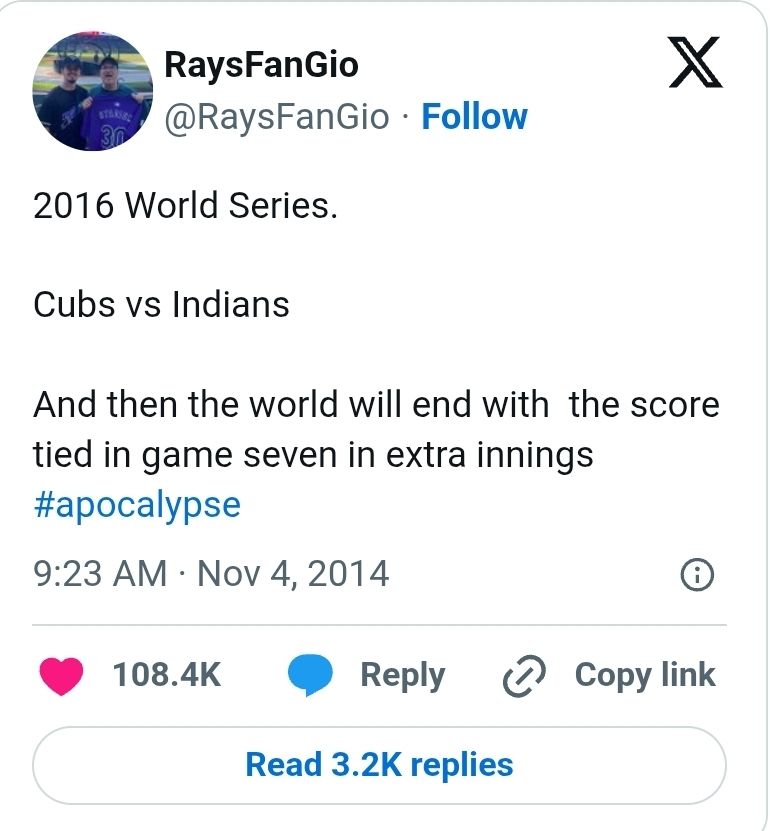
As we briefly mentioned last time around, the Cleveland Indians lost to the upstart Florida Marlins in game 7 of the 1997 World Series. The next time, they would make it back? That hallowed 2016 series that was predicted two years prior. Alas, the Indians (now Guardians) could never capture the elusive Commissioners Trophy to end what is now the longest WS drought, as Boston, BOTH Chicago teams, and even the Houston Astros have gone on to win it all. In fact, the Red Sox won it FOUR times (2004, 2007, 2013, 2016). Even worse? Division rivals Kansas City won it in 2015, while Detroit won the American League Pennant in 2006. KC won the Pennant two years in a row (2014 and 2015). While Minnesota had a long-standing series drought that eventually ended recently, Cleveland had watched what essentially was the majority of their long-time rivals capture the elusive glory they sought since 1948. Was rebranding and getting rid of Chief Wahoo a curse waiting to happen? Whatever the case may be, from 1995-2001, they were AL Central Division Champions 5 times in a 6 year period (2000 was the lone exception). Winning the Pennant in 95 and 97, losing in the World Series to the Atlanta Braves and Florida Marlins respectively. In 2007, they even held a 3-1 series lead against Boston in the American League Championship Series. But Boston, much like they in 2004, channeled that inner magic their core was known for back in the 2000’s and 2010’s and came back to win the series in seven games. Despite winning their first division title in 2007 in six years, it ended more of the same way for Cleveland. In 2013 they lost the AL Wild Card Game to Tampa Bay (the Rays have even made the WS twice, 2008 and 2020, both losses, but in 2008 it was to the PHILLIES, making that sting even more). 2016 was the beginning of three straight division titles for the team, but the 2017 team losing to the Yankees three games to two in the American League Division Series, made the years previous defeat (they were up 3-1 in that series if you recall). All in all, heartbreak for Cleveland baseball fans became a norm.
DAWG POUND
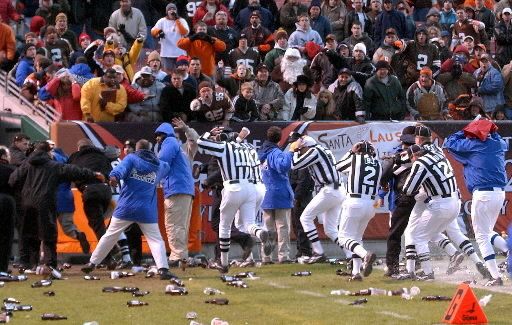
When the Cleveland Browns relocated to become the Baltimore Ravens in 1996, it gave extra motivation for the Cleveland-Baltimore rivalry the city would face in recent years. But, when the Browns returned in 1999, arguably the most beloved team in the history of Cleveland sports, was back where they belonged. But would the new era prove to be any different? If Bottlegate in 2001 was any indication to that, then yeah, I mean, come on, this is CLEVELAND we are talking about! You KNOW shenanigans will ensue……
A RECAP…
For those who likely forgot, I’ll recap the event. In 2001, after the Browns went an embarrassing 2-14 and 3-13 in their first two years back, they finally fielded a team that had a good chance of returning to the playoffsfor the first time since 1994. At 6-6, they were right in the thick of things, with the Jacksonville Jaguars paying a visit to Cleveland for a week 14 match-up. Cleveland trailed 15-10 with the ball facing a 4th and 2 at the Jacksonville 12. QB Tim Couch threw a completion to WR Tracy Morgan for the first down……that is until disgraced referee Terry McAuley decided the NFL rules didn’t apply to this moment. You see, NFL rules state that once another play has been run, under NO CIRCUMSTANCES WHATSOEVER, can a previous play be reviewed. Couch had already spiked the ball, thus eliminating the possibility of a potential review. While Terry claimed the replay booth buzzed down prior to the spike, there is no evidence that backs up his claim. As you’d imagine, they decided to review a previous play despite rules stating that they couldn’t. While Morgan did NOT cleanly catch that pass, and while I fully believe in getting the call on the field correct, this was fully inexcusable on the officiating crews behalf. As the play was ruled incomplete, the Jags got the ball back, winning 15-10. In response, plastic bottles were thrown on the field in protest of the flagrant disregard of the leagues rules, and frankly, I don’t blame the fans for that at all. The NFL allowed Art Modell to relocate a staple of old school NFL Franchises, to Baltimore, (The famous Modell Law was passed in Ohio, it would later save the Columbus Crew Major League Soccer franchise from relocating to Austin Texas) then after watching two painful seasons to get back to where they are now, only to watch the officiating crew botch the simplest of reviews because they decided the rules didn’t apply to them, you can’t blame the fans for being as angry as they were in 2001. On top of that, McAuley tried to have the game called as a result. Commissioner Paul Tagliabue swiftly contacted him, saying he had to finish the game as he had no authority to end the game as he pleased in spite of the safety concerns. The Browns would finish 7-9, missing the playoffs once again.
YOU AGAIN?
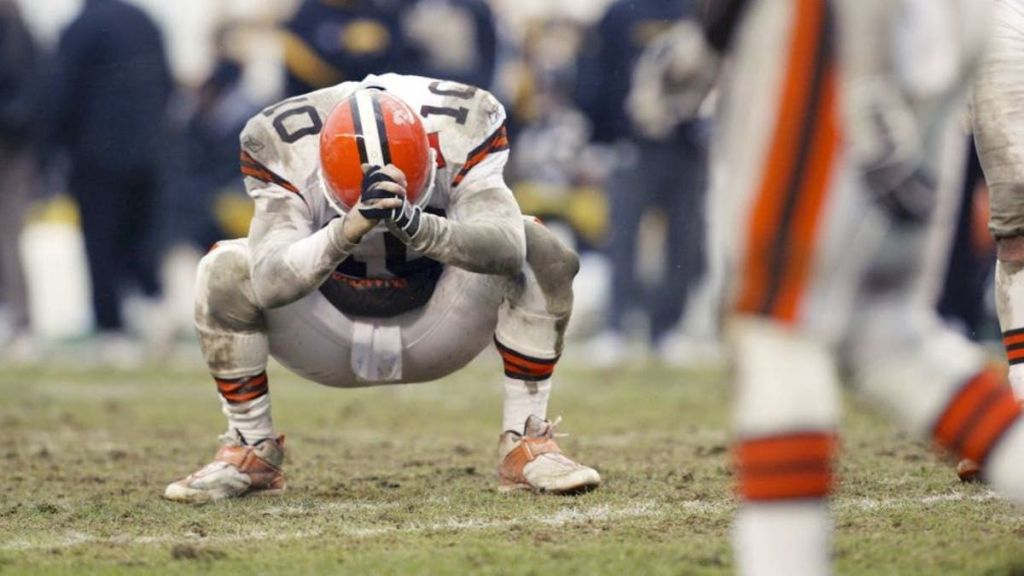
In 2002 though, they would go 9-7 and make the postseason matching up against a long time rival in the Pittsburgh Steelers. Despite getting out to a 24-7 lead in the third quarter, the Steelers would ultimately come back to make this a thrilling game (if not the best) during the 2002 NFL Playoffs altogether, winning 36-33 at Heinz Field in Pittsburgh. With another heartbreaking loss to a long time division rival, time marches on.
THIS AGAIN?
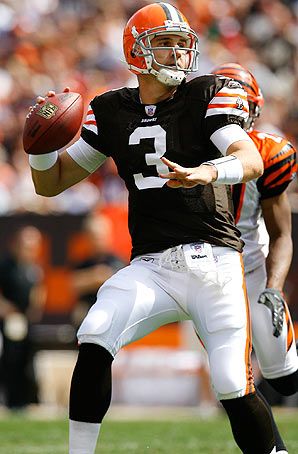
The Browns would fail to register more than six wins again until 2007. That season would see them go 10-6 and play perhaps one the best regular season games in the late 2000’s against their in-state rivals, the Cincinnati Bengals.
Instead of making the playoffs, the Browns were on the outside looking in, thanks to losing both regular season match-ups to the Steelers, costing them the AFC North Division title. Even worse? They lost out to the Tennessee Titans for the last playoff spot in the AFC due to their record against common opponents being the tiebreaker (4-1 vs 3-2). And thus, like the famous 1989 “Cardiac Pack” Green Bay Packers team (full disclosure, I’m a lifelong Packer Backer, owner since 2021) a deadly 10-6 squad who showed they can hang with ANYONE (Green Bay was the last team that beat the 89 49ers, one of the best in history, that season) will not be playing bonus football into the long January months. Even when combined with what I personally believe to be the best Quarterback that has graced the sidelines since Bernie Kosar, the Browns could not get over the hump. Time keeps marching on.
IT WAS THAT BAD, REALLY.
The “Jacks” played nine IHL seasons before along with the league in 2001
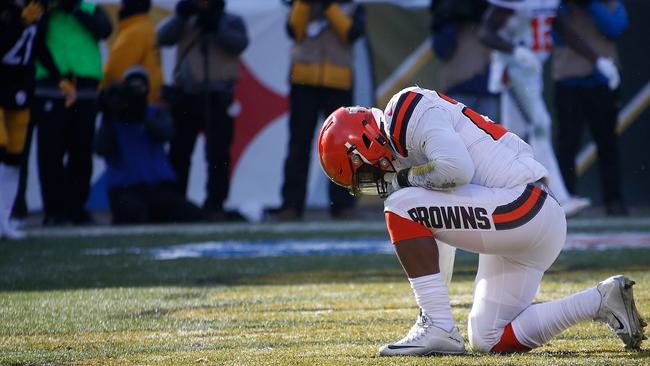
The Browns went 4-44 from 2015-17, worst in NFL history
This era, topped with new unifroms (while a particular favorite of mine, and a collector’s item to many) that were universally despised by Browns fans everywhere, the team would go on to roll out arguably the worst team in NFL HISTORY, being the second winless team in 2016, going 0-16. Although, it could be argued the dreadful era that was the 2007-2009 St. Louis Rams (who went 6-42 in that span in a very weak NFC West Division) were worse in terms of three year eras of hell. The Browns played in a much tougher AFC North that was run by the always rough and tough Steelers, the Baltimore Ravens (who by this point, had won Super Bowl XXXV and XLVII since the teams inception) who were just as every bit as good as their rust belt counterparts were, and last, but not least, the Cincinnati Bengals, long removed from the dreaded “Bungles” era of the 1990’s, as they always had a fiesty squad on defense and a high powered offense that made them a tough out, year in and year out. Hue Jackson was very much in over his head as Head Coach, and one has to wonder what the franchise was thinking? But that doesn’t mean the Browns couldn’t surprise their fan base. Oh no, they did something even more shocking in 2020 when they finally did two things that made us question reality. Some still say it never actually happened. Oh, but it did!
SERIOUSLY?!
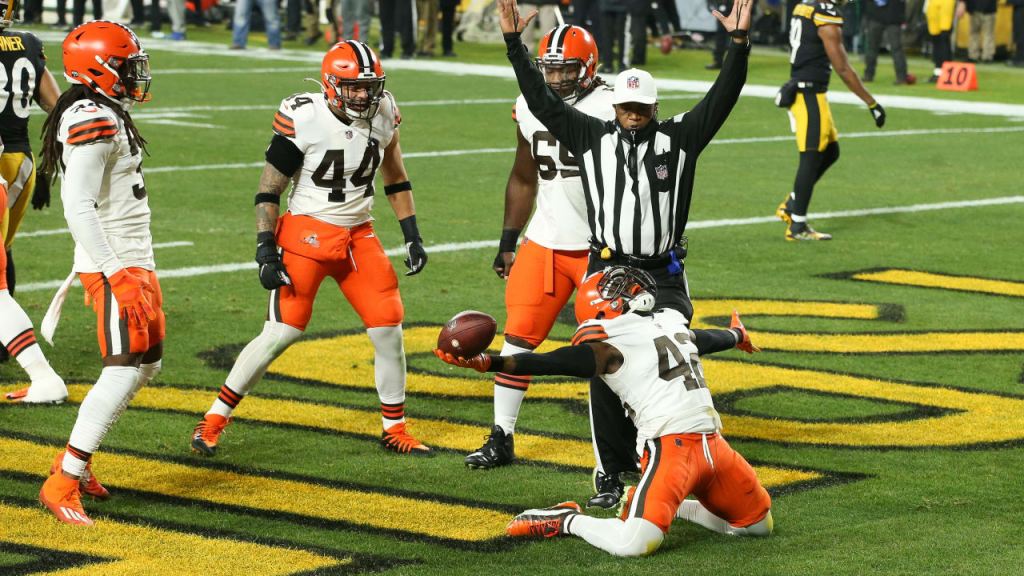
The Browns defeated the Steelers in the 2020 Super Wild Card Round 48-37 despite 500 passing yards
While 2020 provided some long life lessons that bear no repeating, the Browns taught their fans that yes, they could still keep us on our toes. They made the playoffs for the first time since that heartbreaking 2002 defeat. While this technically falls outside our timeline jurisdiction for the day, it’s the 2020 NFL season, so I’ll allow it. Their opponent? Who else would it be? The same team and venue (Heinz Field) from 2002. As a result, that shocked every single fan in the civilized world, the Browns would jump out to a 28-0 lead (yes, you read that right) after the first quarter. Drew Carey would be going nuts at the thought of this happening. It’s a parody you’d see on The Drew Carey Show, but this was really happening, 2020 circumstances or not. If I told you Ben Roethlisberger would go 47-68 for 501 yards and FOUR Touchdowns in this game AND tell you the Browns would win 48-37, while leading 28-0 after the 1st, you’d think I had lost my mind. But on January 10th, 2021, that’s EXACTLY what took place.
The Browns scored on a fumble recovery touchdown in the endzone to go up 7-0 only 14 seconds into the game. Even more wacky? The play started at the Steelers’ 22-yard line, but the snap went over the head of Big Ben, and a scramble for the loose ball led to the recovery by Karl Joseph. On the ensuing drive, the Steelers drove seven plays to their own 48 until Cleveland’s M.J. Stewart intercepts Roethlisberger, setting the Browns up with barely over four minutes gone. Three plays and 46 yards later, Baker Mayfield found Jarvis Landry for 40 yards, and the Browns led 14-0 just 58 seconds later. A three and out drive that elapsed just 2:06 led to another Browns possession. Six plays, 65 yards later, Kareem Hunt goes 11 yards for the third Browns touchdown in as many drives, eclipsing just three minutes exactly on their longest drive of the game so far. The Steelers went three and out AGAIN, taking off only 1:22 and gaining a single yard. Cleveland would pick off Roethlisberger for the second time in the quarter, this time by Sheldrick Redwine, taking it 30 yards all the way back to the Steelers 15 yard line, setting up a three play drive, topped by Hunt’s second rushing touchdown, this one from eight yards out. With 1:56 remaining, after taking off only 1:22 on their latest possession, the Browns inexplicably led 28-0.
Things started to even out just a bit, though not by much, as the teams traded punts going into the second. With 10:11 left in the half, Porter Gustin became the recipient of the third interception on the day, courtesy of Big Ben. The Browns punted, though, pinning the Steelers at their own 11. After a 13 play 89 yard drive that took 5:36, giving the Steelers their first touchdown, would this get them back in the game? With 1:44 remaining in the half, the Browns answered that almost immediately with a nine play 64 yard drive that took just 1:10, with Mayfield finding Tight End Austin Hooper from seven yards out for his second passing TD on the night. The Steelers managed to go 37 yards and get a 49-yard FG by Chris Boswell before halftime, trimming the lead to 35-10. With a 25-point lead at the half, would this be enough to win this time around? Or would the Steelers find another gear, turning the tide as they did 18 years prior?
The Browns punted to start the half. As for the Steelers? They went 84 yards in just eight plays, spanning 3:53. But with 7:22 remaining in the third, down 35-16, time would start to become a factor for Pittsburgh. The Browns went three and out this time, giving the ball back to the Steelers at their own 32. 12 plays 68 yards and 3:25 later, the Steelers would cut the lead to 35-23, starting to make both fanbases wonder, are we about to do this again? SERIOUSLY?! Cleveland punted after another three and out, giving Pittsburgh the ball to start the final period.
The Browns defense forced a three and out, giving Mayfield and the Cleveland offense the ball on their own 20 just eight seconds into the quarter. The Browns responded in just 2:20 with a six play 80 yard drive that ended with yet another 40 yard bomb, this one to Running Back Nick Chubb over the middle, giving the Browns a 42-23 lead with 12:32 remaining. The relief Cleveland fans felt after this one was short lived, as Ben would drive the Steelers in just 1:24 with a four play 76 drive, cutting the lead to 42-29 (for the second time in this contest, the Steelers went for two and failed) with 11:08 remaining. The Browns easied the tensions of their fans driving 13 plays and 59 yards, taking off 6:40. Mayfield’s pass was incomplete on 3rd and Goal from the 6, forcing an FG, but a short one nonetheless, giving the Browns a 45-29 lead with just 4:28 to go. Cleveland’s defense would seal the deal, securing their fourth interception on the day, this one coming from Sione Takitaki. Even though only 25 seconds elapsed on this 4 play drive, the Steelers called two of their timeouts to stop the clock and give them sore time and try to pull off a miracle. After a 37-yard FG, it was 48-29 with just 2:51 remaining, setting up the final Steeler touchdown, giving Roethlisberger over 500 yards on the day. The ensuing onside kick officially sealed the fate of Pittsburgh, giving the Browns a 48-37 victory that, while it had its moments of becoming a repeat of 2002, wasn’t nearly as close as the score indicated at times in the second half. The Steelers were dead last in the league in rushing offense during the season (something completely unheard of in the Steel City), giving Cleveland an ideal gameplan for stopping the high powered potent passing offense led by Big Ben. An inability to run the ball at THIS time of year in the cold, coupled with four interceptions, it was easy to see why this game turned out the way it did. You can’t turn it over five times and expect a sneaky good team, like the Browns were that season, to not capitalize.
While Cleveland would return to earth the following week against the high powered Kansas City Chiefs in the Divisional Round, the Browns 22-17 defeat was as every bit close as this one DOES indicate. The Browns had a chance for a game winning drive with under five minutes remaining, but Cleveland, for some reason, decided to punt with just over four minutes left, setting up Patrick Mahomes to eventually run the clock out, ending the Browns chance of returning to the AFC Championship game for the first time since they made it three times in a four year span back in the late 80’s (86, 87, and 89).
Being a Cleveland Browns or Guardians fan is not for the faint of heart. But, time and time again, as fans in Cleveland have shown to us, they will pour their heart, sweat, and soul into their beloved sports teams as they have done so, long ago when Cleveland Stadium graced over 70,000 fans by Lake Erie many years prior.
If you think being a Browns or Guardians fan is agonizing, try being a Cavs fan. That one might just top Cleveland sports shenanigans all on its own altogether.
But first, did you know the National Hockey League used to play here? They did. For two seasons. It’s true.
LAKE ROYALTY?
The Cleveland Barons played two seasons in the NHL from 1976-78
In 1967-68, the NHL kicked off their “expansion” era, doubling the league from the “Original Six” to 12 teams, adding the Pittsburgh Penguins, Minnesota North Stars, St. Louis Blues, Philadelphia, Flyers, Los Angeles Kings, and the Oakland Seals. The Seals, safe to say, made a number of bag fumbling moves over the years, trading away high quality draft picks (one of those turned into Montreal Canadiens great and All-Time NHL superstar, Guy LaFleur) and overall giving no self respected hockey fans any sort reason to watch this dumpster fire at the Oakland Coliseum in the late 60’s. And why would they? Initially, starting out as the California Seals, the team went 15-42-17, which was good for dead last in the league. The now Oakland Seals, made vast improvement in their second year, going 29-36-11, good enough for second place in the division and a playoff spot in the dreadful western division they played in (which featured all the 1967 expansion teams). This would be the first and only time they would even play off a game. In fact, they won THREE, falling to the Kings in the first round, four games to three. This would ultimately be the high point for the Seal franchise history.
CHARLIE O.
After a brief name change to the California Seals, the new owner, Charles O. Finley, the Oakland Athletics MLB Owner, settled on the California Golden Seals for the remainder of their time in the Bay Area. The Seals did make the playoffs after going 22-40-14 in 1969-70 but were swept in four games by Pittsburgh. The Seals would win 20, 21, 16, 13, 19, and 27 games in their final six seasons (the NHL played a 74 game season in 67-68, increasing to 76 the following year, 78 two seasons later, and finally to 80 in 74-75, shortly before Swig bought the team from Finley), failing to make the playoffs in each of them. Fun fact, the Pens and Seals nearly moved to Denver Colorado AND Seattle Washington (what’s funny, is that the Pens nearly moved to MY hometown of Portland Oregon in the late 90’s, marking the second time the Penguins almost relocated to the Pacific Northwest. They wouldn’t be the last team that threatned to move to either city in the future, however) respecively after the conclusion of the 75-76 NHL Season, the Seals move was originally slated for Denver, but couldn’t be completed in time due to a complication regarding the sale to the Denver ownership group. A potential (and by proxy, a move across the Bay) new arena during a San Francisco mayor election cycle eventually fell through, causing new owner Melvin Swig to relocate the team to the Cleveland, the hometown of minority owners George and Gordon Gund (the latter would pay for the rights to have the new downtown arena named after him), setting the stage for one the briefest stints in NHL history, matching the dreadful two period that marked as the ONLY time Kansas City had an NHL franchise. Remarkable that two great sports cities have had an NHL team to call their own for exactly two seasons and haven’t receieved a team since, yet neither city, nor their fans were the reasons for their failures.
YOU NEW?
The 75-76 season not only saw the Kansas City Scouts relocate to Denver Colorado to become the Rockies (The Denver Bears AAA baseball team still played, nearly 20 years before the BASEBALL Rockies would exist), the Gund’s helped facilitate the move that brought the NHL to Cleveland for the next two seasons as well. The Barons would play their games in the Prince of Wales Conference, Adams Division, along with the Boston Bruins, Toronto Maple Leafs, and Buffalo Sabers. Despite tying on points for the final playoff spot, the Barons missed out, going 25-42-13. The following season, after Swig was denied a bailout by the NHL due to financial difficulties, sold to the team to the Gund Brothers, making them sole majority owners. While the team drew worse than the Seals did at the box office (something the Crusaders, more on that in a moment, never had issues with), the Gunds aggressively marketed the team and spent LOTS of it, doing just that. And while things looked to be turning around on the ice, going 22-45-13, missing out on the playoffs, narrowly once more, there were financial problems that continued behind the scenes, forcing the franchise to ultimately merge with the Minnesota North Stars, prior to the 78-79 season. Despite having upset victories during the season that showed progress was being made on the ice for a bright future, Cleveland, like Kansas City just before them, would be two and out as an NHL city, despite rumors of the Candiens looking at moving to the city back in the mid 1930’s, with the NHL off and on considering Cleveland as an NHL city prior to and after this.

Cleveland Indian’s player Mickey McGuire circa 1930’s.
The Barons’ NHL run may have been over, but this is merely a footnote in the City of Cleveland’s hockey history. The Knights played in the Eastern Amateur Hockey league for one season in 1949-50, withdrawing after going 4-10-4 through 18 games. The city’s first hand at professional hockey goes back to 1929-30 with the Cleveland Indians. They would play in the old International Hockey League. The team would become the Falcons in 1934, moving to the now American Hockey League in 1936-37, their final season. They made the playoffs both times in the IHL, losing to London two games to none in 1935 and three games to one to Buffalo the following year. But the core of Cleveland’s hockey success may have come from the FIRST to call itself the Barons from 1937-73. That’s right!
The original Cleveland Barons played in the AHL for 36 years 1937-1973, winning NINE Calder Cups in their successful history.
The original Barons would play in the AHL for 36 seasons. Those were filled with some pretty good success, too. The Barons won eight regular season titles (38, 44, 45, 47, 48, 50, 51, and 53) while winning 10 division titles along the way (38, 41, 44, 45, 47, 48, 50, 51, 53, and 62). Even better? The Barons would win the Calder a staggering NINE times in their 36 year run (39, 41, 45, 48, 51, 53, 54, 57, and 64), making them the winningest team in Cleveland sports HISTORY. That’s more than the Browns eight up this point, and the Indians/Guardians two (1920 and 1948). Sadly, in those days, hockey wasn’t looked at fondly around the United States as it is now. Hockey was also a much different beast in those days.
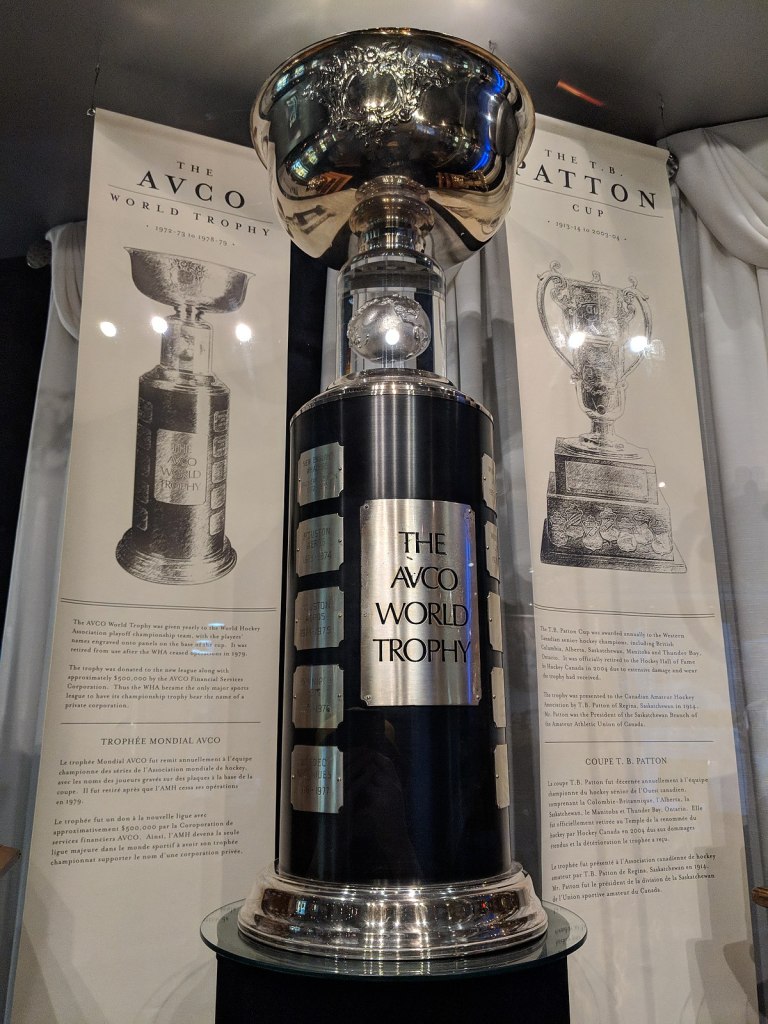
Remember the old Western Hockey Association? The League that now only had teams like the Houston Aeros, Hartford Whalers and Quebec Nordiqiues, but featured one of the most remarkable trophies in sports history with a globe floating in the clear neck the trophy? The Avco World Trophy would blow minds even by today’s standards in the sporting world. Today’s kids would want that.
The Cleveland Crusaders played just five seasons from 1972-1976
Well, Cleveland had a brief history that dabbled with WHA Hockey as well, lasting only four seasons. The Crusaders would play from 1972-73 to 1975-56, the year prior to the NHL Barons moving into the Richland Coliseum. They would average just shy on 6200 a game at 6197. While they made the playoffs in all four seasons they played, Cleveland only made it past the first round once, their inagural campaign, before falling to Hartford Whalers in the second round. The team was owned by Cavs founder Nick Mileti, who also owned the Cleveland Indians at the time, bringing another pro team into his portfolio. While Jay White and Mileti would sell the team back to one another a few years later in 75 and 76, the Barons moving in meant the beginning of the end for the Crusaders. After failing to move to Hollywood, Florida, the team would eventually (in an ironic twist) relocate to St. Paul Minnesota and become the second version of the Minnesota Fighting Saints, making the Minnesota-Ohio connection all the more ironic.
Next up, we have the short lived Cleveland Lumberjacks, who played in the once fabulous International Hockey League for nine seasons from 1992-2001. The Jacks’ would make the Turner Cup Playoffs in seven of those seasons, making it to the second round in three of those, but advancing to the Eastern Conference Finals only once, losing to the eventual champions, the Detroit Vipers in 1997, four games to one. The Lumberjacks never won a division title and only finished as high as second just once (their inagural season). The IHL folded entirely after the 2000-01 season, ultimately ending the Lumberjacks run. The city would be without a hockey tennant once more, but not for long, as the AHL came calling once again, this time in the form of the relocated Kentucky Thoroughblades. Bringing a familiar name and branding back to the City of Cleveland, the Barons.
From Lexington Kentucky to Cleveland, the franchise had some interesting logos, to say the least
The Barons most recent incarnation would play five seasons as an affiliate to the San Jose Sharks. They made the playoffs just once, losing to Hamilton four games to two in the second round of the Calder Cup Playoffs in 2004. The team relocated to Worcester Massachusetts prior to the 2006-07 season ending the Barons’ most recent run to date. The team branding still lives on, abeit differently.
Current Cavs Owner, Dan Gilbert would purchase the inactive Grizzlies shortly after, bringing the now Lake Erie Monsters into the fold, ensuring the City of Cleveland remained a hockey town once more, also playing in the AHL.
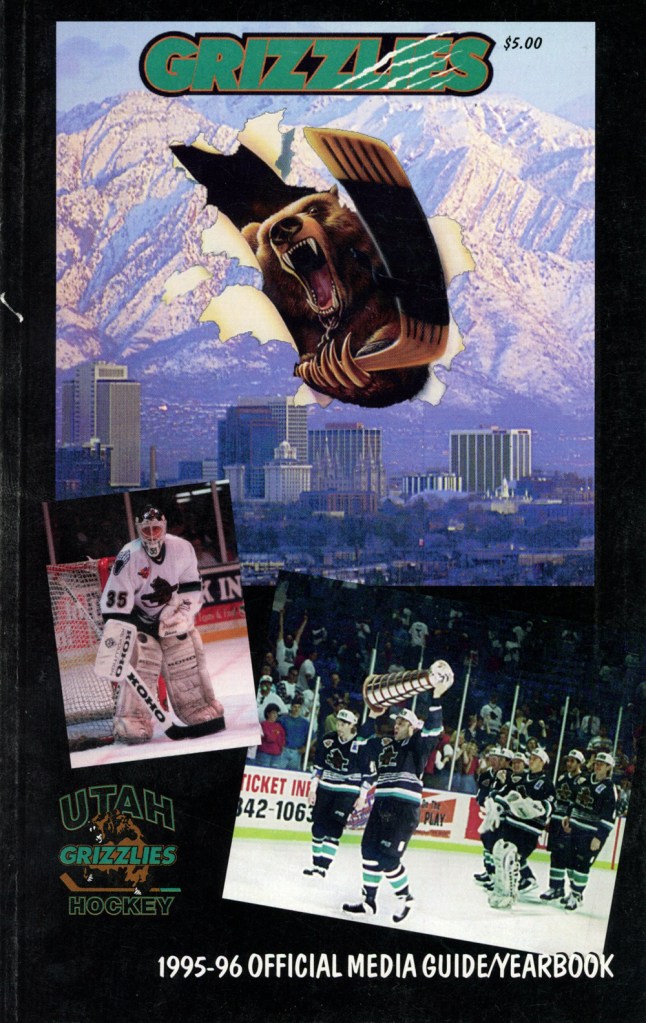
The roots of the Monsters go back to a once dominant team, the Grizzlies, who were a force to be reckoned with during their heyday, be it in Denver or Utah.
Speaking of those Monsters….the team started out in the IHL as one of the best first year teams in the HISTORY, the Denver Grizzlies. Denver would take the NHL lockout shortened 94-95 season by storm, winning the Turner Cup. The next season saw the Quebec Nordiques tragically relocated to Denver, becoming the Avalance. As a result, the Grizzlies moved to Salt Lake City Utah, keeping the Grizzlies name and colors. Salt Lake was once home to the Golden Eagles who played from 69-94, spanning three seperate leagues and winning five cups (three Adams Cup titles in the CPHL and the Turner Cup in back to back seasons, 87-88), so Utah was not new to professional hockey. Ironically, the Golden Eagles would relocate to become those very same Detroit Vipers we talked about, in 1994, leaving Utah without a hockey team for just one season. 1995-96 would see that rectified with the move of the Grizzlies. While the UTAH Grizzlies weren’t as dominant as their Denver counterparts were, they still captured the Turner Cup in 1996 in front of over 17,000 fans at the Delta Center giving the City of Salt Lake City Utah (and the State of Utah)their sixth professional ice hockey championship. The franchise had back to back cups, albeit in different cities. The Avs won the Stanley Cup in 1996, giving the title of “City of Champions to Denver Colorado in ice hockey two years in a row with different teams and leagues, too.
The Grizzlies would eventually join the AHL in 2001 after the IHL folded. The team never made it past the second again after their triumph in 1996. They failed to even win 40 games in the regular season in all but one of their seasons in the AHL (their first) losing in the second round that season. The team was suspended a few years later in 2005 voluntarily eventually being relocated to become the Monsters that fans know and love today.
“Monster Town USA” is born with the addition of the Lake Erie Monsters in 2007
The 2007-08 season marked another return and era for Cleveland hockey fans, making Cleveland, Ohio “Monster Town USA” among the inner circles. With an affilation to the nearby Columbus Blue Jackets in hand, the Jackets and Monsters enjoyed a great partnership in developing talent over time. This Buckeye State connection gave Ohio hockey fans two teams to root for at two separate levels. The AHL today acts as an AAA league to the NHL, much like the Pacific Coast League and International League does for Major League Baseball. It would take four seasons before the Monsters saw any postseason action, making the Calder Cup Playoffs in 2010-11, losing to the Manitoba Moose, four games to three in the first round. Five years later? The Monsters would change the city hockey landscape forever when they made a trip all the way to the Finals in 2016.
MONSTER CUP RALLY
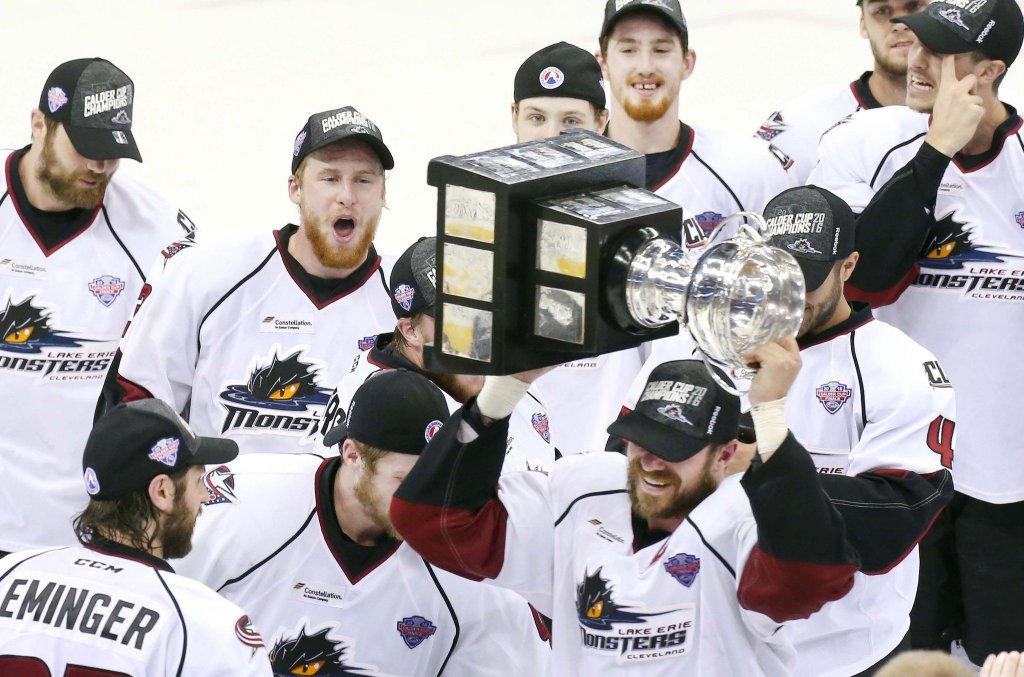
The Lake Erie Monsters won the Calder Cup in 2016 over the Hershey Bears, city’s 10th win.
The Monsters got another taste of playoff hockey in 2016, making this ride (and the year of 2016 for Cleveland sports fans in general) the best sports run going back to 1948 when the city saw a (debatable) three banner sports year (Barons Calder Cup in the AHL, Browns won the AAFC, and Indians won the 48 World Series). The Monsters squared off against the Rockford Ice Hogs (Chicago Blackhawks affiliate), winning in short effort, three games to none, they defeated their hated rivals, the Grand Rapids Griffins (Detroit Red Wings affiliate, continuing the Wings-Jackets rivalry, and by extension, the Michigan-Ohio rivalry) in the next round four games to two to make the Western Conference Finals against the Ontario Reign (Los Angeles Kings affiliate). The Monsters stormed on the Finals, taking down the Reign, four games to nothing in a dominant effort, sending a message to the Bears that there might be a new king on top of the AHL. The Bears (Washington Captials affiliate), were shut down in short order, also in a four game sweep (including 1-0 in game four), giving the City of Cleveland their 10th professional ice hockey championship. With the help of Portland Winterhawks draft pick Oliver Bjorkstrand and leading playoff goatender Anton Forsberg, the Monsters went 15-2 during the postseason, making them one of the best Calder Cup Champions in recent memory.
The Monsters would formally change their identity to the CLEVELAND Monsters the following season, an identity they have even to this day, though they wouldn’t make the postseason again until 2019, falling in the second round to the Toronto Marlies (Toronto Maple Leafs affiliate) in a four game sweep. The city of Cleveland has a very long illustrious history in hockey, but as for grabbing headlines? Try being a Cavs fan for THAT one. While hockey in Cleveland didn’t have a lot of press, you could expect the Browns and Guardians to make that up. But as for the Cleveland Cavaliers NBA team? That team got more than anything (maybe in the City of Cleveland sports history COMBINED), when they went to draft a tall and confident 6’9″ player out of St. Vincent-St. Mary’s High School in 2003.
BELIEVELAND
Fair or not, the Cleveland Cavaliers are the city’s most popular sports franchise in Cleveland’s history
The Cavs came into the NBA the same year as the Buffalo Braves (yes, Buffalo had an NBA squad at one time), and the Portland Traiblazers (as someone born and raised in “Rip City”, I know the Blazermania all too well as a diehard myself) in 1970-71. While the Braves would relocate to San Diego in 1978 to become the San Diego (later Los Angeles, in 1984) Clippers, the Blazers and Cavs remain in their market to this day. Portland even won the Finals in 1977, becoming the first team to win four straight in the Finals after losing the first two games of the series. Thus, “Blazersmania” was born. The Cavs, on the other hand, would have to wait much much longer to receive their coveted crown (if ever).
MIRACLE AT RICHLAND
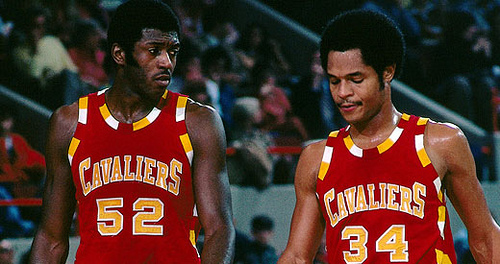
The “Miracle at Richland” defined the 75-76 Cleveland Cavaliers
Ted Stepien was so inept during his time at the helm of Cavs ownership that the league itself had to make a rule barring teams from trading their first round draft picks in consecutive years. This brief period (1980-83) made the Cavs completely unwatchable in so many ways I can not begin to state how or why. Prior to this, the Cavs were actually a good squad to come see, making the playoffs three straight years from 76-78, they made it to the Eastern Conference Finals, in 1976, winning the central division title, but losing to the Boston Celtics four games to two, after a thrilling win in seven games against the Washington Bullets. The Celtics won the Finals against the Phoenix Suns 4-2.
ORANGE AND BLUE CRUSH

Brad Daughtery made the Cavs a dominant force, winning 57 games in 1991-92 season, a then record
Shortly after Stepien’s meddling was behind the organization, the Cavs found success almost immediately, making the playoffs in 85, but lost three games to one the Celtics once more. Three years later, Cleveland found its way back to the postseason where they would make consecutive trips from 88-90, but failing to advance to the second round each time, losing to the Michael Jordan led Chicago Bulls twice and to the Philadelphia 76ers in 1990. Two years later, the Cavs, still playing at Richfield Coliseum, would make another run to the Eastern Conference Finals behind the best team the City of Cleveland had EVER seen, going 57-25 and yet somehow they finished second in the central, to (you guessed it) the Bulls. Chicago went 67-15 that year! The Cavs took down the New Jersey Nets, three games to one in the first round and the Boston Celtics in a tough seven game series, ending the Larry Bird Celtics era, with a 122-104 win at the Rich. Despite winning games two and four to even the series twice, Michael Jordan and the Bulls proved to be too much, punching their ticket to the 1992 NBA Finals (Portland, who ALSO won 57 games, fell to the Bulls, despite arguably Clyde Drexler’s greatest performance to date, in six games) four games to two, winning game six at Richland Coliseum in a tight one, 99-94. The Bulls would sweep the Cavs in the second round, four games to none the following season, despite winning 53 games in the 1992-93 season. The Bulls swept them three games to none in the first round in 1994. The Knicks would finish them off in the first round the next two years, 3-1 and 3-0, respectively. Goes to show you just how many jaw droppingly good teams were denied titles in the 90s thanks to Jordan’s Bulls. Cleveland would lose to the Indiana Pacers in first round 3-1, in 1998, ushering in the era that Cleveland would be known for, putting them not just the NBA’s, but the World’s stage Ready or not, Cleveland was center stage.
THE CHOSEN ONE
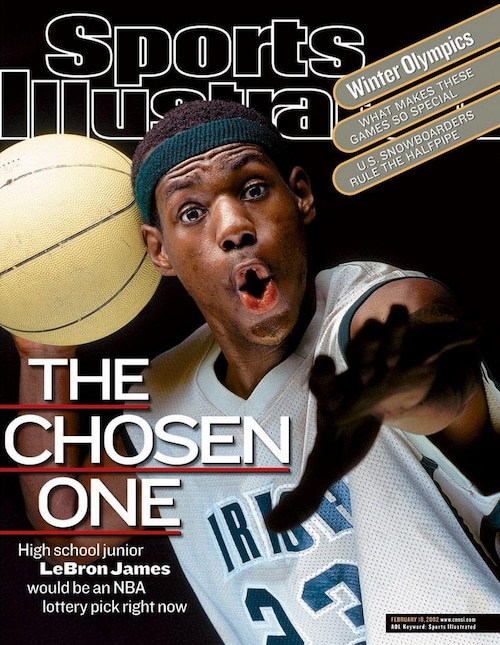
LeBron James defined not just Cleveland, but sports altogether
The 2003 NBA Draft took place at the Madison Square Garden in New York, NY, on June 26th, 2003. But on May 22nd, the Cleveland Cavaliers won the NBA Lottery Draft on this day for the rights to select a local kid from Akron out of St. Vincent-St. Mary’s High School, by the name of LeBron James. Long before, he slashed the paints and excited ESPN and ABC viewers on a nightly basis. He made the Irish basketball team the best in the country. After losing a hard-fought game in Trenton New Jersey in November 2002 to the Number One High School team in the country, the Oak Hill Academy Warriors, 72-66, on December 12th, 2002, LeBron and the Irish regrouped in Cleveland in front of over 10,000 fans embracing “LeBronmania” at the Convocation Center. The game was even nationally televised, marking the first time in his soon to be long illustrious career that he would play a nationally televised game. After being held scoreless for much of the 1st period, LeBron would soon make his presence known, going off for 31 points, 13 rebounds, and 6 assists, leading the Irish 65-45 at home.
Despite trying to enter the NBA draft prior to his senior year of high school, NBA draft rules (which have NEVER allowed a current high school student to be drafted), prevented this, thus forcing him to wait until after he graduated to be eligible. This controversy ultimately led to the leagues current “one and done” rule making players eligible to enter the draft after being one year removed from their high school graduation. The orignal “prep to pro” rule initally stated that is needed to four years, though this was relaxed somewhat in 1971, but players needed a college degree in most cases. Moses Malone (an ABA and NBA superstar) was the first great player to go from prep to pro back. Another notable example? Oh, just some guy playing for the Los Angeles Lakers at that time (with three titles in hand, mind you) named Kobe Bryant. As far back as the time he was playing for the Irish, LeBron was often considered the next Michael Jordan. He wore 23 quite often throughout his career. Even with Kobe winning titles under former Bulls Coach Phil Jackson, Kobe may have been the face of the league currently, but that was about to change, as Kobe never was able to carry the banner for the league himself, though he came close compared to most, the way Michael did. Clyde Drexler was also a much closer carbon copy, if not better, than Michael was at the time. Jordan never saw Kobe (or LeBron, for that matter) as a true threat or comparison. After all, he took it PERSONALLY when he was compared to “The Glide”. If Michael Jordan really took THAT to heart? I think all the titles and success of the Lakers have fogged the goggles of Laker fans who don’t realize how good and otherwordly Clyde Drexler truly was.
FEAR THE SWORD
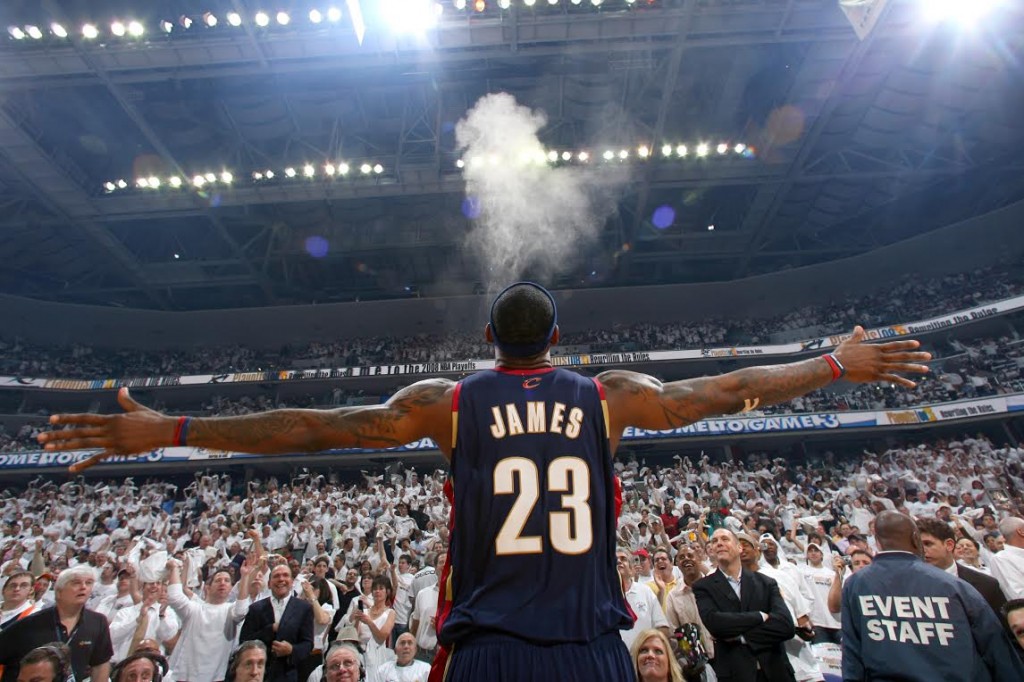
For better or worse, the Cavs had their man, and Cleveland, it’s Savior to lead the charge in Ohio
While the NBA likely had a hand in gifting a rudderless franchise the keys to their future (they have a LONG history of doing this, sadly, and proven beyond a shadow of a doubt through numerous documented evidence) the Cavs and the City of Cleveland were ready to enter in to this marriage and forge what many hoped against all odds to be the greatest era in their franchise history. And they weren’t wrong. Just not at first and not the way that it was originally drawn up.
The Cavs nearly made the playoffs in his rookie year, going 35-47 and missing out on the playoffs by just one game. Year two proved to be more of the same, this time with a winning record at 42-40, but missing the postseason by losing out on a tiebreaker to the Nets. The third time was the charm, it seemed, as the Cavs won 50 games and captured the four seed setting up a match-up with the Washington Wizards in the first round. The Cavs took down the Wiz four games to two and faced off against the Detroit Pistons, who gave them a crash course in playoff experience, making their FIFTH consecutive trip to the Eastern Conference Finals. Detroit advanced in this one, four games to two. The following season saw the Cavs reach new heights that the Miracle and 92 squad couldn’t.
LESSONS LEARNED
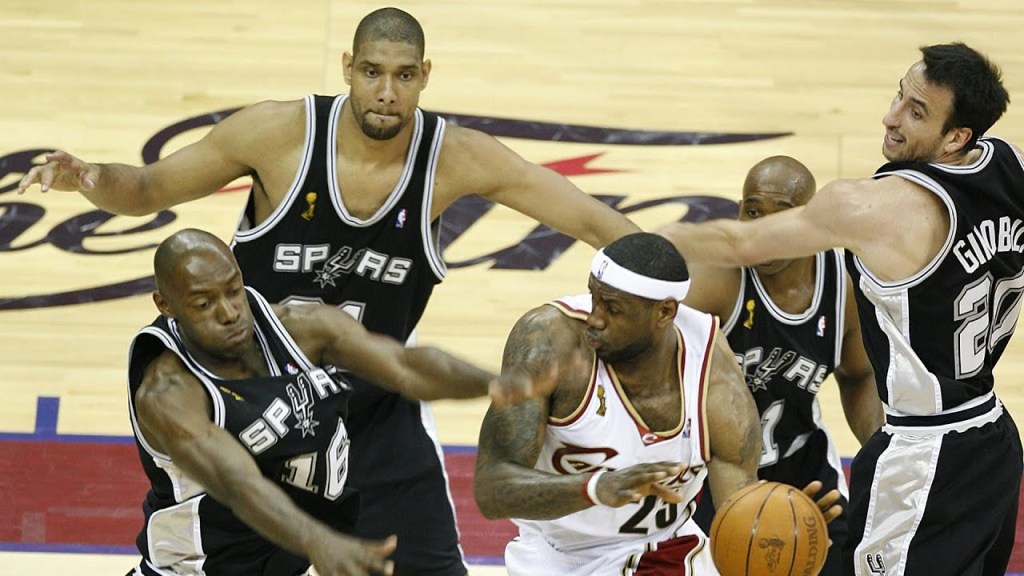
LeBron found out the hard way that the San Antonio Spurs were a tough draw in the mid 2000’s playoffs
The Cavs won 50 games once more, finishing behind Detroit. This time, the Cavs swept Washington in four games in the first round while taking down a tricky Nets club in six, on their way to a rematch with Detroit in the Eastern Conference Finals, the SIXTH consecutive Conference Finals for the Pistons. Cleveland ended the run that was the “Modern Day Bad Boys” four games to two to make their first trip to the NBA Final. The opponents they faced were not unfamiliar to the stage, as the Spurs won it all in 1999, 2003, and 2005 prior. The Spurs proved just how much of a dynasty and force they were in the day, toppling King James in four straight, 85-76, 103-92, 75-72 (in a game that Spurs Forward Bruce Bowen likely fouled LeBron on a potentially game tying 3 at home, causing LeBron to get visably upset with officials afterwards), and 83-82, rallying with a 12-3 run late to capture the crown in a four game sweep.
PARTY OF THREE
Cleveland made it back to the second round the next year as well, but after winning only 45 games and finishing fourth in the East, they still took down the Washington Wizards in six games. The Boston Three Party, led by Kevin Garnett, Ray Allen, and Paul Pierce, sent the Cavs home after a hard fought seven game series. The Celtics would win the title the following month against the Lakers in six games. The next two seasons would see the Cavs accomplish something not seen since the Miracle at the Rich, a division title! The Cavs unloaded upon the rest of the league, going 66-16 and getting the top overall seed. They swept Detroit and the Atlanta Hawks in the first two rounds, setting up an Eastern Conference Finals with the upstart Orlando Magic, led by Center Dwight Howard. Orlando proved to be a much better team than advertised, knocking aside Cleveland in just six games on their way to the Finals (the Lakers would redeem themselves, beating Orlando in just five games).
2009-10 would prove to be a little seen forthcoming swan song of sorts, as Cleveland would capture back to back division titles, going 61-21 this time around, while taking down the Bulls four games to one in the first round. But like all good things, this too, came to an end, in more ways than one. The Celtics were back with a vengence, taking down Cleveland in just six games on their way to winning the Eastern Conference, where, thanks to Joe Crawford’s typical meddling, saw the Lakers win the Finals in seven games with Kobe receiving free throws like they were candy, in the fourth quarter of the deciding game. Some say He gave up during the series against Boston and had his mind elsewhere. What Cleveland fans weren’t prepared for, was a decision that would change their lives (seemingly forever) and the rest of the Cleveland sports scene.
DECISIONS (FOR WORSE)

2010’s “The Decision” was only topped by 1996’s “The Move” in the history of Cleveland Sports infamy
On July 8th, 2010, in a nationally televised event on ESPN, LeBron held his free agency decision over a block program to announce that he would be choosing to not return and sign with the Miami Heat in the offseason, angering not just the city of Cleveland, but the State of Ohio as well, stabbing the backs of Cavs fans who looked upon him to save the city from their long sports suffering. Instead, he joined up with Dwayne Wade and (formerly with the Toronto Raptors) Chris Bosh, giving the Miami Heat a big three, similar to what Boston did a few years prior.
THERE WERE WARNINGS
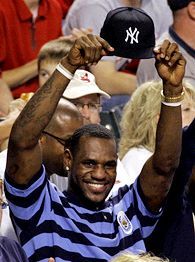
Those who saw past James’ “Savior” status in Cleveland know this was common practice for him to irritate the masses just to garner clicks and views. From wearing a Yankees hat during a Cleveland Indians playoff game against New York, to rocking Buckeyes gear when they played against the Miami Hurricanes in football, King James was known for drawing attention to himself in all the worst ways possible. In the modern day and era of social media and going viral, LeBron made sure he stayed on top of most everyone’s attention in some way or another.
DECISIONS (FOR BETTER)
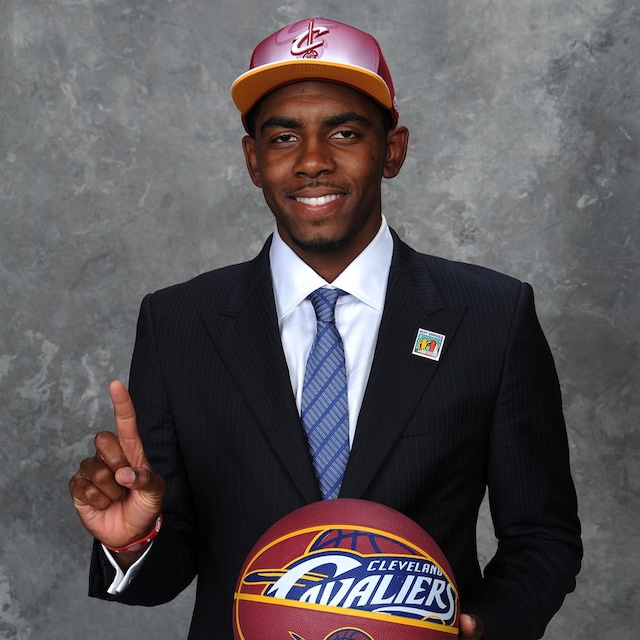
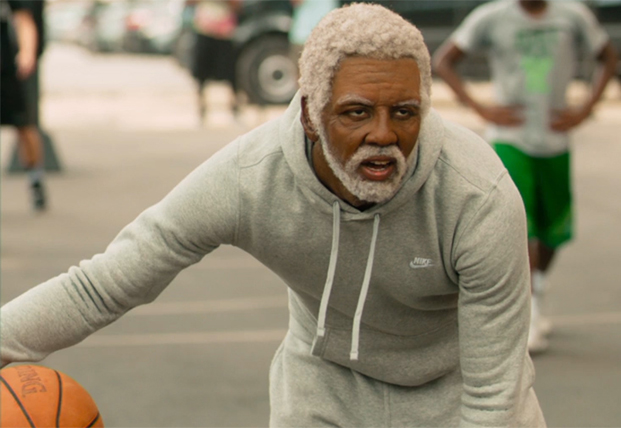
“Uncle Drew” taught us all to not reach while restoring our faith in the Cavaliers franchise once again
The first season in the post LeBron era was every bit as bad as you would expect, going 19-63, futility not seen since the Stepien era. But a new era was about to brew as the Cavs would get to select first after winning the draft lottery for the 2012 NBA Draft (big surprise at this point). They selected the man who made Cleveland a City of Buckets. Uncle Drew, Kyrie Irving from Duke, was selected. The first season in the Uncle Drew era didn’t see as many buckets as we hoped (even though Irving won Rookie of the Year), going 21-45 in a lockout shortened season. Even worse? This was the second of FOUR STRAIGHT trips to the NBA Finals for the Miami Heat, winning two of them (2012 and 2013), giving LeBron twice as many as the Cavs did, further angering Cavs faithfuls. The next two seasons started to see slow but steady improvement, winning 24 and 33 games, respectively. 2014-15 would start arguably one of the greatest redemption arcs in the history of not just Cleveland sports, but, for LeBron James personally.
HOME COOKING
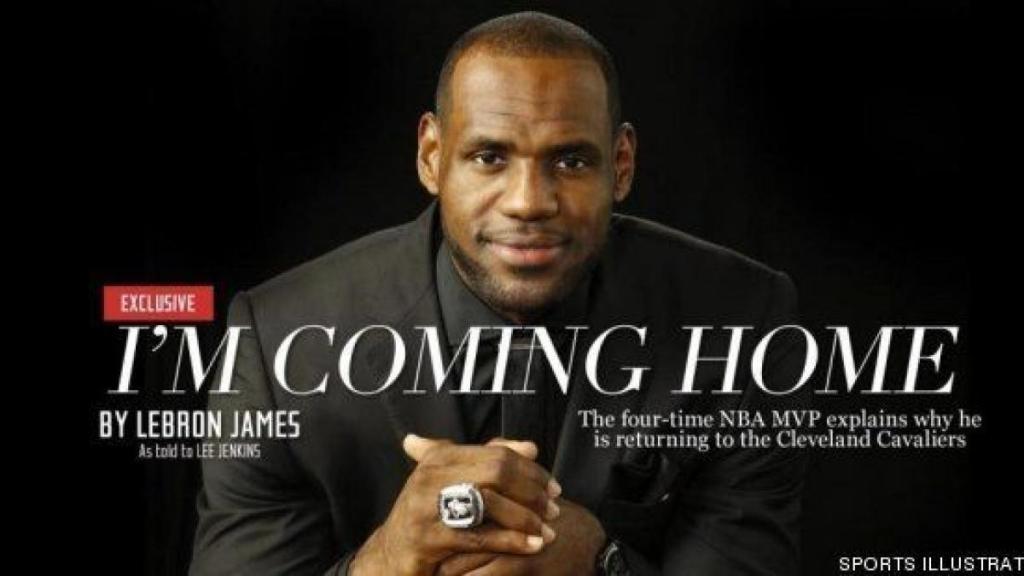
LeBron came back home, thus redeeming himself fully in the hearts of Cavs fans everywhere
After four straight trips to the NBA Finals in Miami, with the lure of new and better talent than previously seen in Cleveland the first time around, the Cavs were able to bring back the man once thought to be their Savior. In July 2014, LeBron James announced he would be signing another deal with Cleveland, giving the Cavaliers an incredibly improbable yet likely chance of reaching the Finals the following season. Cleveland not only did just that, winning the division at 53-29, but took down the Celtics (4-0), Bulls (4-2), and Hawks (4-0) along the way. The final challenge? The upstart Golden State Warriors, led by Steph Curry, Klay Thompson, Draymond Green and Andre Iguodala, “The Death Lineup” as they would be come to known as, during the beginning of what would be a great dynasty for the otherwise snake bitten franchise. The Cavs lost Kevin Love before the start of the 2015 Finals, only to lose Kyrie Irving after their game one loss. While LeBron, Tristan Thompson, and Matthew Dellavedova clawed and scrapped their way to keep “The Grit Squad” in the series (leading 2-1 at one point), The Death Lineup proved to be too much, as the Cavs fought bravely and fell in the next three games, 103-82, 104-91, and 105-97 on home court to give the Golden State Warriors their first NBA Title in 40 years, since Rick Barry swept Elvin Hayes, Wes Unseld, and the Washington Bullets in four games, in 1975.
Next season would take Cavs fans to heights and hallowed ground that gave them all the peace they would need (until the Browns and Guardians follow suit) to rest as fan in one of the grittiest sports cities, Cleveland Ohio, in 2016.
BELIEVE IN THE LAND
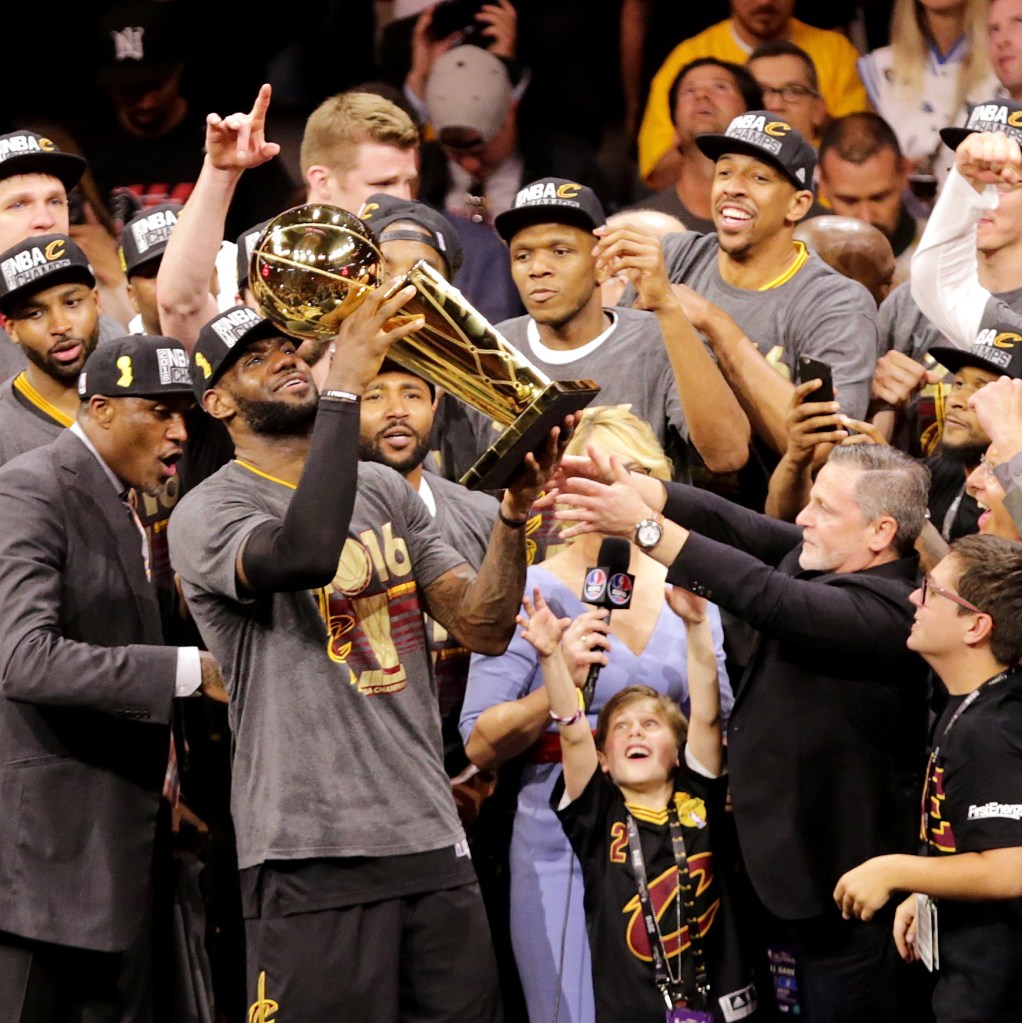
The Cleveland Cavaliers won the 2016 NBA Finals in arguably the most improbable way possible
Believeland gathered nightly, some 20,000 fans on hand at Quicken Loans Arena (now ROCKET FIELDHOUSE), ready for the time that was destined, redeeming a man fully though to be the city’s Savior, along with many other who joined on this journey. From the Wine and Gold of the Miracle at the Rich to the Orange and Blue Crush of Price and Daughtery. The Black and Sky Blue dark days to the navy, red, and gold era that led us to now. Cleveland was ready to finally turn a corner. Would this year be any different? The Warriors went on to win 73 games that season, besting the 1996 Chicago Bulls (still considered the best team of all time by many experts and fans alike) proving that a new sheriff among the NBA’s all time elite, was here to stay. The Warriors took down the Houston Rockets and Portland Trailblazers 4-1 in the first two round before they nearly got upset (YES, Draymond should have been suspended for what he did) by the Oklahoma City Thunder in the Western Conference Finals after falling behind 3-1, but came back to win back to back Western Conference Championships. Cleveland swept Detroit and Atlanta in the first two rounds before taking down the Toronto Raptors 4-2 to set up a rematch in the Finals with the Death Lineup Warriors. And a chance to redeem.
A 3-1 LEAD
Golden State showed no mercy on the Cavs in the first two games, winning 104-89 and 110-77, putting the Cavs in a 0-2 hole. Would a series shift to Cleveland in front of the hometown fans provide the spark needed to get back in the series? Cleveland responded in a big way, handing the W’s a 120-90 defeat to trim the defecit. Game four proved to be a major turning point for both teams, despite the Warriors 108-97 win on the road, putting them up 3-1. Drayond FINALLY received comeupance for his groin hits he would become known for doing during his career, becoming the first player since Jerry Stackhouse in 2006, to be suspended during the Finals. Cleveland took advantage of the absence of Green, winning 112-97 back in Oakland, sending the series back to Cleveland just one more time and giving the fans one last chance to see their beloved Cavaliers. Andrew Bogut (who managed to somehow stay healthy all of last years playoffs) was lost for the year after injuring his knee in this game five tilt. Even with Green back for game six, the Cavs had a 31-11 lead after the first, ensuring the 20,562 in attendence they would be sent home happy. Cleveland won 115-101, setting up arguably the greatest game, and by default, the greatest demon excercision the City of Cleveland would ever see.
THIS ONE’S FOR YOU!
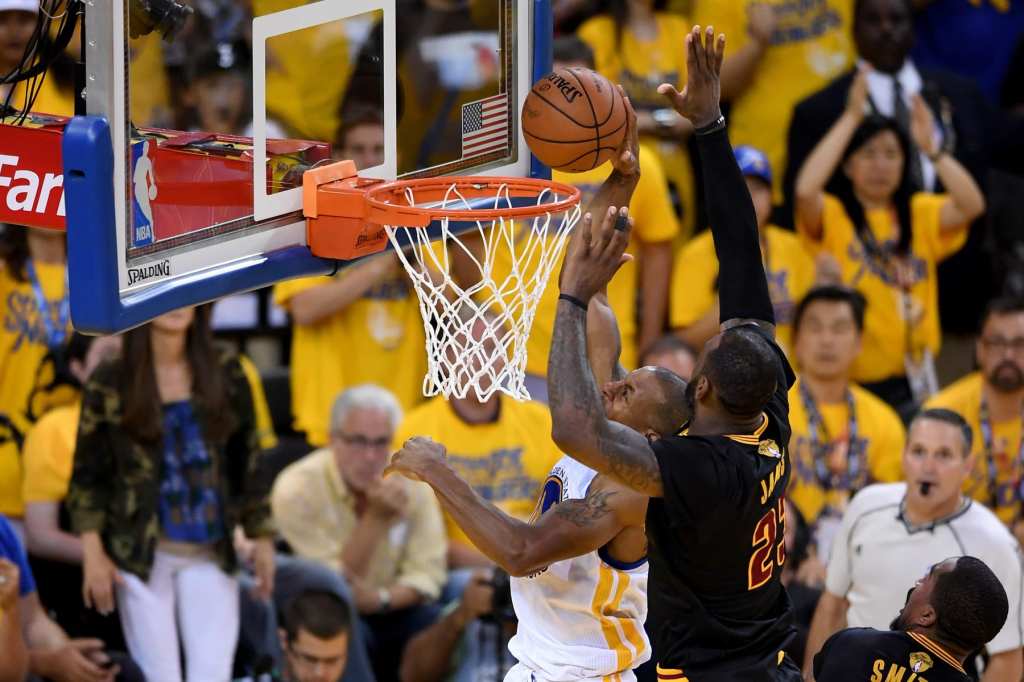
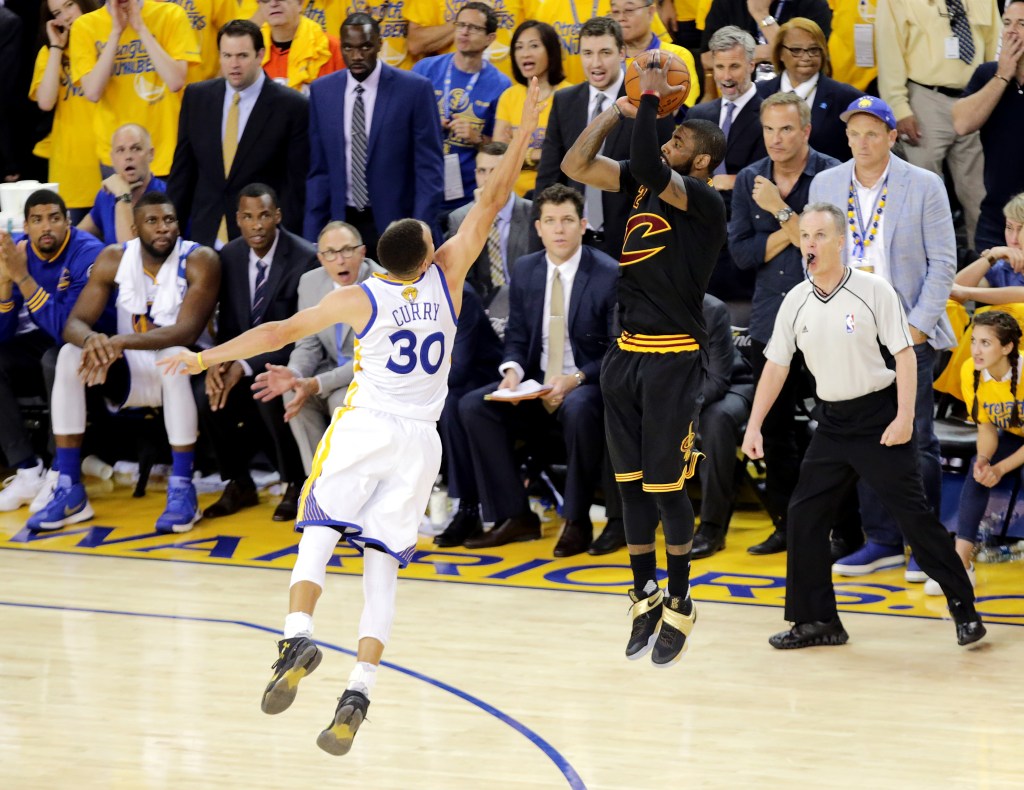
Game 7 of the 2016 NBA Finals saw one of the best finishes in Finals HISTORY, topping even 1969’s
Going into the final game of this season, both teams had scored 610 on the nose in the Finals through the first six games. Draymond Green nearly had a game seven triple-double, going 32-15-9 to lift Golden State in this tilt. LeBron countered with a true game seven triple double, with 27 points, 11 rebounds , and 11 assists to pace Cleveland. The Cavs led 23-22 after one, while the Warriors led at the half, 49-42. The Cavs trailed after three, 76-75, setting up the greatest game seven finish in NBA Finals history. True basketball fans, they were rooting for the Cavs, while the flash and splash and all that came with it, rooted for the Dubs. This was the only contest that was decided by single digits. The final 4:39 of the contest saw the vaunted Death Lineup Warriors fail to score. Tied at 89 with 1:50 to go, King James delivered a block that would make Tayshaun Prince proud of, on Iguodala. With 53 seconds remaining, Uncle Drew got the biggest bucket of his CAREER thanks to a reaching youngblood in Steph Curry, putting the Cavs up 92-89 (both teams had scored 699 points in the series prior to that shot). A free throw by LeBron with 10.6 second left, iced the game sealing the Death Lineup’s fate and capturing the Cleveland Cavaliers first World Championship, 93-89.
The Cavs became the first team to win the Finals after being down 3-1 (thus creating the “blew a 3-1 lead” meme) and the first to clinch all their series on the road since the Spurs did so in 1999. They also became the first team since the 78 Washington Bullets did so against the Seattle Supersonics to win game seven on the road in the Finals. Cleveland won their first “big four” sports title in 52 years, and by extension, the State of Ohio their first in 26 years (the 1990 Cincinnati Reds won the World Series) Clevelaaaaaand! This one’s for you! The Finals MVP said.
THE AFTER YEARS
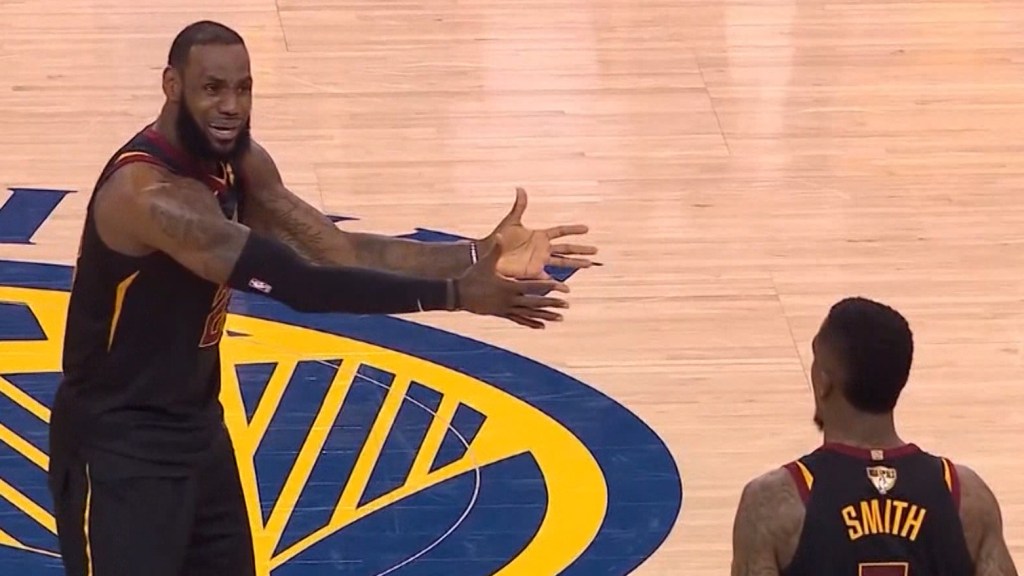
The post 2016 era was defined by this moment courtesy of J.R. Smith in 2018 and losing to the Warriors
The Cavs would never repeat as champions, despite running it back to the Finals along the way for the next two seasons. They won 51 games while taking down the Pacers (4-0), the Raptors (4-0), and the Celtics (4-1) to win back to back Eastern Conference titles. The Warriors, bolstered by a free agent Kevin Durant, who broke the hearts of Oklahoma City Thunder fans by joining the W’s, took down Cleveland in just five games, after sweeping all four Western Conference opponents along the way, giving the 67-15 team one the best runs in modern history, mirroring the 2000-01 Lakers run to the Finals. After the greatest choke in Finals history, Golden State ran it back to take their second title in three years.
The following season saw yet another Warriors-Cavs Finals, with Cleveland winning 50 games and taking down the Pacers (4-3), Raptors (4-0), and Celtics (4-3) thus capturing FOUR consecutive Conference Championships. Golden State followed suit, going 58-24, defeating San Antonio and the New Orleans Pelicans 4-1 in the first two rounds, while taking down Houston in seven to win the West for the fourth straight season (but not without some notable controversy that can’t be ignored). The Warriors would make it three in four years, although J.R. Smith may have helped their cause, too, in a sweep. This became the first time in sports history to see the same two teams meet in the championship four straight years in ANY sport.
THE LAND IS BARE AGAIN
The Cavs core would go their seperate ways after four straight trips to the Finals (EIGHT in total for LeBron), thus ending an illustrious era that was soon to be ripe for picking for the Cleveland Cavaliers once more. The next two seasons saw them only win 19 games each (the latter for reasons that led to life lessons). While the Cavs were rocking the arena for years upon end, did you know that some talented women made Cleveland a destination for WOMEN’S professional basketball? That’s right. Cleveland is a basketball town no matter who.
CLEVELAND ROCKS
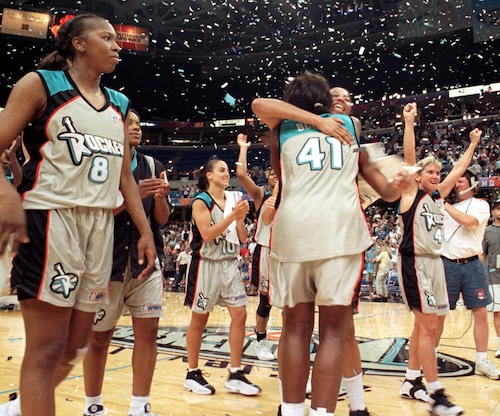
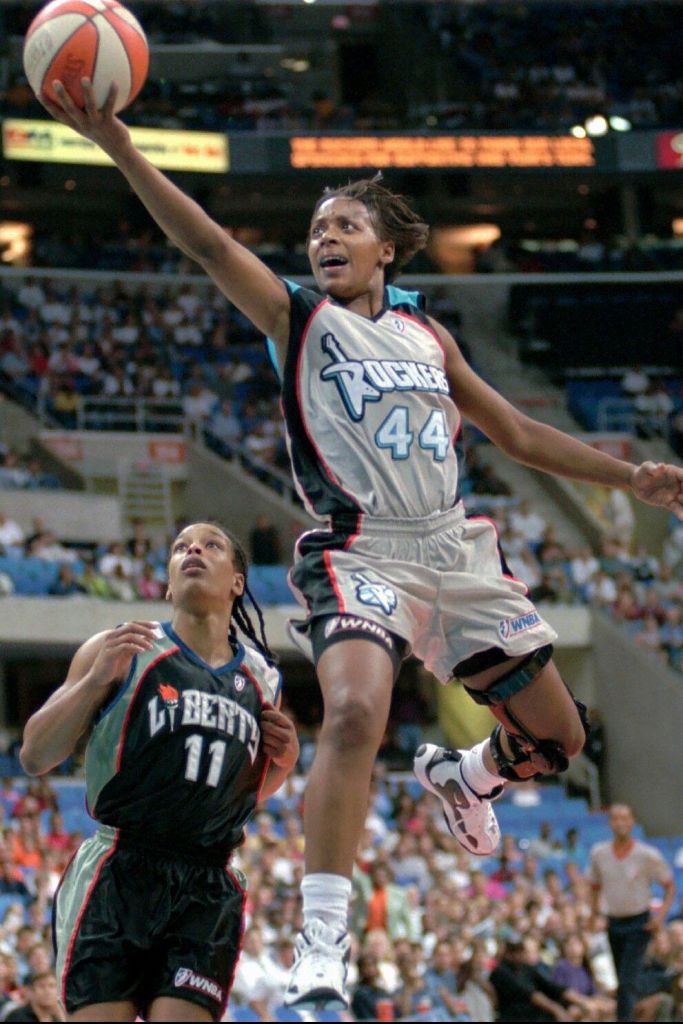
The WNBA’s Cleveland Rockers played seven seasons in the Land
In 1997, Cleveland Ohio was granted one of the original eight franchises to play in the 1997 inagural Womens National Basketball Association season. The team was named “Rockers” in ode to the nearby Rock and Roll Hall of Fame. The Rockers silver, blue, and black colors, along with a guitar based logo, made them a popular choice among favorite franchises in the leagues history. In 97, the Rockers would miss the final playoff spot on a tiebreaker to the Charlotte Sting. Even so, they had a winning season at 15-13. The following year, The Rockers posted the WNBA’s second best record, only to the Houston Comets (who went 27-3) and best in the East, at 20-10. They would be matched up with the Phoenix Mercury in the Semi-Finals. They lost game one in Phoenix 78-68 before capturing game two in front of 10,465, 67-66 in a squeaker. Sadly, the run ended in game three, winner take all, as the Mercury defeated the Rockers before 8420 at Gund Arena, 71-60. The following year would see the Rockers out of tune, going 7-25 in what turned out to be their worst season in franchise history. The new millennium brought better tides and good fortune for the Rockers, seeing them go 17-15. Good enough for second in the much weaker East. They would even win a playoff series. They would take on the Orlando Miracle in the Eastern Conference Semi-Finals, losing 62-55 in game one, before rallying back to take game two before 9755 at home, 63-54. In game three, the Rockers put on their best performance thus far, taking down Orlando to advance to the Eastern Conference Finals against the New York Liberty, 72-43 with 9528 at Gund Arena.
THE SHOW MUST GO ON
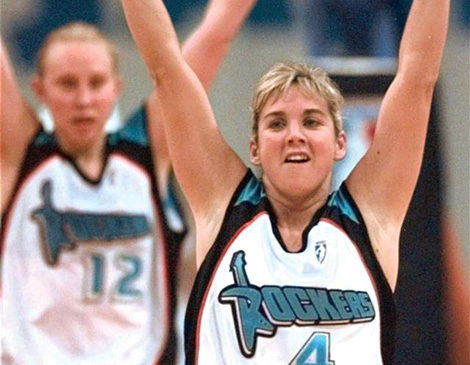
The Rockers made the Eastern Conference Finals just once
The Rockers moved one step closer to their first trip to the 2000 WNBA Finals with a 53-46 win in game one before 11,686 at home. This would be the closest the Rockers ever came to glory during the run in the WNBA overall. The Liberty regrouped and took the next two games, 51-46 and 81-67, to take the series two games to one. In 2001, Cleveland posted their best regular season mark in their franchise history to date, going 22-10 and taking the top spot out East. Only the top team out West, the Los Angeles Sparks (28-4) were better. The first round saw the Rockers paired up against the Charlotte Sting. Cleveland got off to a bad start losing game one 53-46 only to force game three with a win at home, 69-51. Game would see the Rockers band disbanded for the season after getting Stung by visiting Charlotte, 72-64. The sixth season in Rockers history ended almost as bad as it did three years prior, going 10-22 and missing the playoffs. The last season in 2003 saw Cleveland go 17-17 and make the playoffs in their swan song in the City of Cleveland. Their opponent was the Detroit Shock, the best team in the regular season standings. The Rockers’ last home game in franchise history was August 29, 2003, as they fell in game one of the 2003 Eastern Conference Semi-Finals, 76-74. The Rockers did fight back to take game two 66-59 to force one more game in Detroit. The Shock overpowered Cleveland disbanding the Rockers for good with a 77-63 win in game three. The Shock would go on to win the 2003 WNBA Finals against the Sparks, two games to one.
Thus ended a brief yet thrilling seven years show for women’s basketball in The Land.
But we have one more sport to circle back to before we end our long winded sidequest on the day, and that takes us back to…..the beautiful game? Really?
SECOND DIVISION,
THIRD TIER,
CITY STARS
The United Soccer Leagues Cleveland City Stars lasted just three seasons from 2007-09
In 2007, the United Soccer League Second Division (Third on the US Soccer pyramind then, only to USL First Division and MLS) saw a team take the field in Cleveland Ohio as the Cleveland City Stars. Based out of Krenzler Field (ironically, on the Campus of Cleveland State University), the City Stars would go 10-1-9 in the inagural campaign, good enough for second only to the Richmond Kickers. They would face off against the Harrisburg City Islanders in the 2007 USL Second Division Semi-Finals. A crowd of 1478 saw Steve Fisher give the Islanders a 106th minute mark, sending them to the 2007 USL Second Division Championship against Richmond (who beat the Charlotte Eagles, also in extra time with a 110th minute goal). The Islanders would finish the job (unlike the Heat in their NPSL heyday), taking down the Kickers 8-7 in PK’s after a 1-1 draw in regulation, making them the 2007 USL Second Division Champions.
The 2008 USL Second Division campaign for Cleveland proved to be the most underrated banner in Cleveland sports history. The City Stars went 10-3-7, good enough for third overall behind Charlotte (13-2-5) and Richmond (14-4-2). 1634 packed Krenzler to see the City Stars square off against the likes against USL 2nd Division classic teams, like the Charleston Battery, Pittsburgh Riverhounds, Western Mass Pioneers, Wilmington Hammerheads and Crystal Palace Baltimore.
The 2008 USL Second Division Playoffs would see the top six teams make the postseason with the four hosting the five to play the top seed, with the three playing the six in order to face the two in the Semi-Finals. In the 2008 USL Second Division Quarterfinals, Crystal Palace Baltimore (in their only playoff appearence as a team through their four year, 2007-2010 history) took down the defending champions 2-2 (7-6). Cleveland defeated Western Mass 4-2 ,thanks to a Pioneers red card in the 44th by Leszek Wrona in front of 1683 at Krenzler Field. The Semi-Finals saw Charlotte come from behind against Crystal Palace Baltimore after giving up an early tally in the 5th to Shintaro Harada (and a red card by their own player in the 90th, Terry Boss), to send the Eagles to the Finals. The City Stars faced off against the Richmond Kickers at City Stadium in Richmond, Virginia. Adam Ruud provided a 99th minute goal to send 2693 in disbelief as the Cleveland City Stars would face the Charlotte Eagles in the 2008 USL Second Division Championship. The City Stars struck twice in the first half. Musa Otieno, in the 15th and by Sallieu Bundu in the 39th. Charlotte countered with a strike from Joseph Kabwe late in the 87th, but it was not meant to be for the Charlotte Eagles, as 2016 at Krenzler Field saw the Cleveland City Stars win the 2008 USL Second Division Championship, 2-1.
FALLING STARS
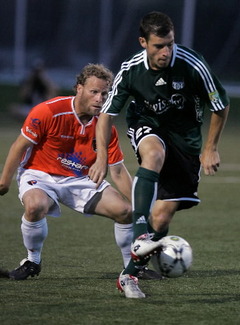
The Cleveland City Stars came back to earth before folding in 2009
Finally, in 2009, the City Stars moved up to USL First Division for what turned out to be their third and final season in existence. This also put them in the second tier just behind MLS now. The team also moved their home games to Bedford High School in the Cleveland suburb of Bedford, Ohio. The move to the second-tier USL First Division proved to be a disasterous experiment, as the City Stars finished dead last among the 11 teams at 4-19-7. The City Stars would fold soon afterward due to financial issues after the season.
This ends the tale that built up the post Crunch years (before, during, and after). I have to say, this took way longer to write than I initially expected to, yet was fun to highlight as Cleveland continues to show just how rich their sports history is professional, regardless of the sport, place, or venue.
Come back tomorrow as we highlight the return of the Cleveland Crunch in 2020!
The Cleveland Crunch returned for the 2020-21 MASL2 Arena Soccer season, ready to leave their mark.

 Starball Sports and Entertainment
Leave a comment