How the beautiful game indoors made Cleveland Ohio, a City of Champions.
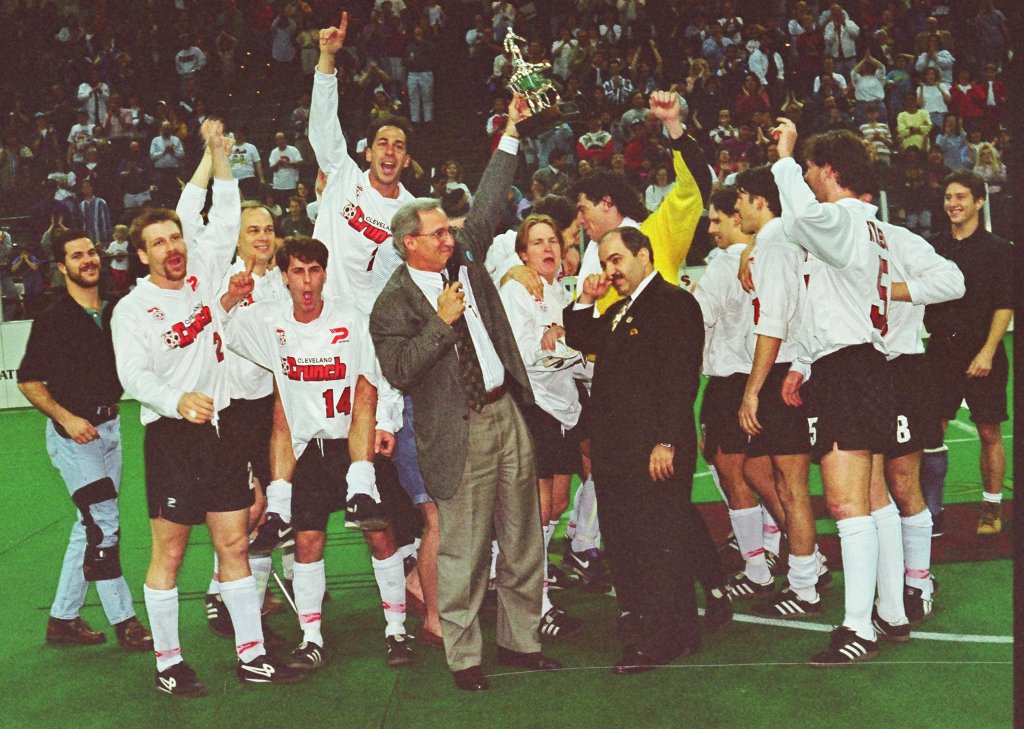
Tears of joy flow, as The Cleveland Crunch celebrate their 1994 NPSL Championship at the Cleveland Convocation Center over the St. Louis Ambush.
By Delorean Fleetwood
Cleveland, OH: Today, we pick up right where we left off with the birth of the team that made Cleveland a City of Champions in the modern day. To recap, in 1988 shortly after the beloved Force played their last game, losing to the San Diego Sockers in game 4 of the 1988 MISL Championship, Bert Wolstein, citing declining attendence (despite the on field success they continued to have), was frustrated with the lack of committment from other league owners towards their own teams. Not only that, but with teams starting to fold up shop left and right, it led to the difficult decision to not bring back the Force the following season. It was in this moment of heartbreak that led to the greatest comeback the City of Cleveland had seen, maybe going back to 1948. With Akron businessmen George S. Hoffman and Stuart Lichter forming the ownership group, Force star turned player/coach Kai Haaskivi manning the sideline, the newly minted Cleveland Crunch would proceed to bring back some former Force faces from the mid 1980’s to start their inagural season. With the pieces in play to bring arena soccer back to Cleveland, the Richland Coliseum would soon be rocking to the sound of off the wall action and wallascoras that fans became accustomed to seeing the last 10 years. The Cleveland Crunch would began play in the 1989-90 MSL season, giving the band a year to bring it all together. Cleveland, would soon rock once again to the sound of missiles and high scoring family fun come 1989.
In 1989-90, the Crunch, like the Force before them, would begin their inagural season finishing last place in the Eastern Division, going 20-32. While the Crunch did not make the six team playoffs in 1990 out of the now eight team MSL, the energy missing from this once rabid fan base was back and ready for another round of arena soccer action. One could be forgiven to not see the Crunch make it to the postseason as most of the roster did contain players that were already past their prime and heyday when they played for the Force a few years prior. Nevertheless, the roots were planted and a solid foundation had been set. The Crunch, were here to stay, even if the MSL soon wouldn’t in the near future with all the foldings going on left and right. Even being one of the two teams to not make the playoffs couldn’t dampen this already passionate fanbase that was all but ready to embrace the team that would soon make them champions. Even with only 5543 in nightly attendence, this too would soon change with time.
The 1990-91 season would soon bring fruits to that hard fought labor as a trade would be made to bring arguably one the best players in the era (and a former rival that broke many the hearts of Force fans in the past) Hector Marinaro, a former Minnesota Strikers star (he scored an OT winner as previously mentioned in PT 1) was brought back to Cleveland, as he played in just five games during the 83-84 season, a very little known fact regarding his career. Finally, the trade that brought it all together was acquiring fiesty Sockers forward Zoran Karic for Paul Wright pairing together this dynamic duo who would make the Crunch an absolute force to be reckoned with for the next decade. League wide, a change was also made, as the league would rebrand itself as the Major Soccer League (dropping the I). With a solid one-two scoring punch leading the attack in Cleveland, the Crunch, as expected, made a stark turnaround from last season, finishing on top of the Eastern Division at 29-23, netting them a division crown in only their second season, something that took the Force eight seasons to accomplish. They also had the third best record in the league behind the Sockers (34-18) and a new team running it back in St Louis, the Storm (32-20). What may come as a shock to most fans, some felt the Force wasn’t just the same as the new Crunch were, and prehaps the trek out to the Richland Coliseum wasn’t worth it at this point (to be fair the Richland Coliseum was nowhere near the downtown core, but had also long outlived its use as an entertainment facility by this point). As such, only 4640 a night came to watch the birth of something truly amazing in the City of Cleveland’s long illustrious sports history. With the top six teams, three in each division, making the playoffs once again, the Crunch would be rewarded with a bye to the Eastern Division Finals. Their opponent? The Kansas City Comets, another well regarded franchise with its own great history and backstory. The Comets had just polished off their first round opponent, the Wichita Wings (another great squad that the fans always represented quite well, they too, have their own amazing history) 2 games to 0. The 1991 MSL Eastern Division Finals is still considered by some to be one the best playoff series in arena soccer history. Crunch vs Comets was set. While only 5357 saw the Crunch dictate the tempo in their 7-2 game 1 win, game two saw a nearly doubled crowd for their 7-5 game 2 win, with 10,021 packing the RC. KC picked up an OT game 3 win 7-6, thanks to Carlos Valentine, while the Crunch would counter with a tight 5-4 win at Kemper Arena for game 4, putting them up 3 games to 1. Needing to win game 5 at home to extend their season, the Comets did just that, laying claim to a game 5 victory in a tight 5-4 contest. With the Crunch up 3 games to 2 heading back home, 7239 fans packed it in for game 6 only to see the Comets bravely fight back to force game 7 by a score of 8-6. The Crunch, in front of 12,718 just three nights later, would win a thrilling game 7 in front of the hometown crowd, picking up their first trip the Finals with a hard fought 7-6 win in hand. The Sockers would be their opponent in the finals, having just tossed aside St. Louis 4 games to 1 to take the Western Division. 1991 would prove to be a much different result compared to three years prior, but would it be enough? San Diego took game 1, 8-4. But, the Crunch now did something the Force NEVER did, they WON a Finals game, against the mighty San Diego Sockers to boot! Game 2 ended with yet another one goal margin, 4-3. Cleveland would have their full slate of home games for the Finals (the format in the finals for best of seven is 2-3-2). Game 3 saw the Sockers take this one 6-5 in front a crowd of 14,571 on hand. 10,831 would see the Crunch tie the series, winning 7-5. Game 5 would be crushing blow for the Crunch as they only could muster a single shot in the back of the net in a 6-1 defeat before 12,102. Despite the bravery this new up and coming squad displayed during the season, reaching heights the Force could only hope of seeing, the Sockers would take game 6 by a score of 8-6, winning the 1991 MSL Championship 4 games to 2. The Crunch had two of the leagues top five scorers (Karic was 2nd with 73 goals and 48 assists for 121 points, while Marinaro was 5th with 63-44-107) and yet they still couldn’t reach the top of the mountain, at least not yet. While it was certainly agonizing to see yet another heartbreak in the “Mistake by the Lake”, the Crunch had made their message quite clear, they were not only here to stay, but with Marinaro and Karic leading the Crunch attack, they would be a force to be reckoned with for the years to come. When would they finally break through? Will they? Seems that things really are different this time around, aren’t they?
HELLO DARKNESS MY OLD FRIEND…
1991-92 would not only be the FINAL season in the leagues now 14 year history, but it might be the final chance to see an arena soccer squad in Cleveland finally get that long coveted crown in the missile launching, off the wall, beautiful game indoors that has come to delight fans in the City of Cleveland, Ohio since the late 1970’s. With the Comets folding, the league was now down to just seven teams on the year. As a result, a single table, without divisions, would mark the regular season. The Crunch would finish 3rd with a 20-20 record in a 40-game regular season. Only San Diego (26-14) and Dallas (22-18) finished with a better record. An improved 7056 attendance showed up in the teams final season at the Richland Coliseum as well. The Crunch drew Dallas for their Semi-Final series. The Sidekicks would protect their home turf with 6-3 and 7-6 wins in the first two games. Down 2-0, the Crunch fought back in front of 8752 to take game 3, 7-6. Dallas responded with a game 4 win in front of a crowd of 7289, 8-7. With their backs against the wall for what might be the final show in front of their home fans, the Crunch gave not only the fans in Cleveland, but the Richland Coliseum itself, a victorious send off, winning 8-7 in front of just 7913 in game 5. Game 6 would ultimately prove to be the last game in the MISL/MSL history for the Cleveland Crunch, as they would fall at Reunion Arena 8-4, sending the Sidekicks to the last MSL Championship. While Dallas trailed 3-0 in the Finals, they came back to ultimately force game 6 before the Sockers would claim the title, 4 games to 2. And with that, the MISL/MSL was history. But what’s this?
A NEW DAY, A NEW WAY
From the ashes of the MSL, rose the NPSL and a new league was born
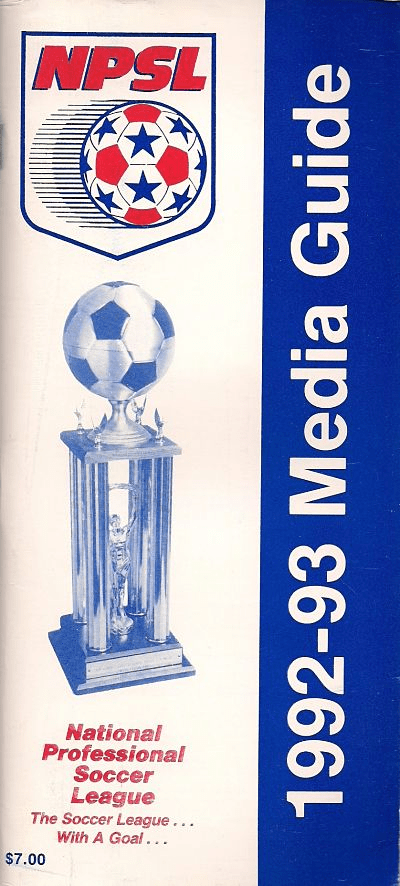
Media guide for the 1992-93 NPSL season.
The roots of the now National Professional Soccer League go back to 1984 as a feeder league to the MISL for up and coming talent, similar to what the Arena Football League did with Arena Football 2. In terms of rules and reglations, the then American Indoor Soccer League (AISA) was almost identical to the bigger and more popular league, the MISL. That would change in 1988-89 when the AISL would institute goals that ranged anywhere from one to three points depending on where the goal was scored on the field of play. With this new, exciting scoring pace that mimics the NBA somewhat, an arc would establish three point goals if scored from behind this line. Two point goals were scored from inside the arc, but outside the box (similar to the “key” or “paint” in basketball). The good ol’ fashioned single-scorer could be netted anywhere inside the boxed area next to the goal.
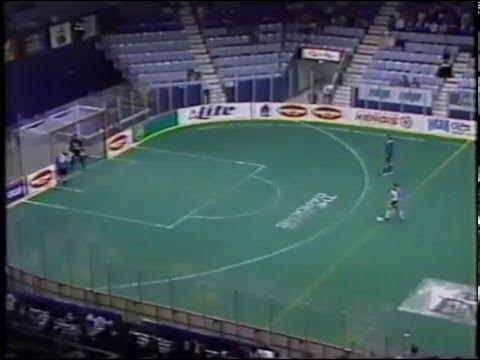
NPSL playing field. Crunch vs. Silverbacks at the Cincinnati Gardens in 96-97.
The AISA also mimicked the AF2 in that smaller to medium-sized markets were the good to for franchises across the nation. Cities such as Milwaukee (one of the pillars of the game thanks to the now seven time World Champions, the Milwaukee Wave), Cincinnati, and Detroit made their passion known, as they too, packed the arenas their squads played in, just as San Diego, Dallas, Kansas City, and Cleveland had done in their MISL glory days. With a new pathway and a new league to join, the Cleveland Crunch, along with the Wichita Wings , oined the much more stable NPSL.
CONTINENTAL CHAMPS?

The Continental Indoor Soccer League lasted five seasons from 1993-97.
The Sockers and Sidekicks joined ANOTHER new league that came to be known as the Continental Indoor Soccer League (CISL) in 1993. The CISL would also eventually fold up shop in 1997 after five solid years of high flying action that brought even local TV stations to broadcast the action. The CISL itself was founded by former Los Angeles Lazers (and Lakers) owner, Jerry Buss, who felt it was more profitable to have their leagues season during the summer months as to not clash with any other basketball or hockey teams, allowing more dates for arenas when it normally would be dark during the long summer offseason. The CISL would also see the City of Las Vegas, Nevada claim their first professional sports World Championship with the Dust Devils in 1994, defeating the defending champion Sidekicks 2 games to 1 (CISL Finals were a best of three, Dallas defeated San Diego the previous year 2 games to 1). An international squad, Monterrey La Raza, got in on the fun with two CISL crowns defeating the Sacramento Knights 2 games to 1 in 1995 and the Houston Hotshots 2 games to 0 in 1996, going back to back. Finally, the State of Washington would see their first and only World Champion in the sport (sorry Tacoma fans) when the Seattle SeaDogs defeated the Houston Hotshots 2 games to 0, giving the Evergreen State, the Pacific Northwest, and by extension, Cascadia, the last great championship that would grace the sport in 1997 (if you were to believe the naysayers beyond that season). Some say the sport wouldn’t be quite the same after the 1997 CISL Finals, Seattle vs. Houston. THAT would prove to be false as the Crunch, along with the likes of the new Kansas City Attack and the previously mentioned Milwaukee Wave, would pave the way in the years to come for the sport of arena soccer and for the NPSL. Would a new league and new rivals make a difference? Only time would tell, but the Crunch didn’t just have a new league to play in or rivals to play against, but they had a new venue to call home as well.
CONVOCATION CHAMPION
The newly built Convocation Center was built on the campus of Cleveland State.
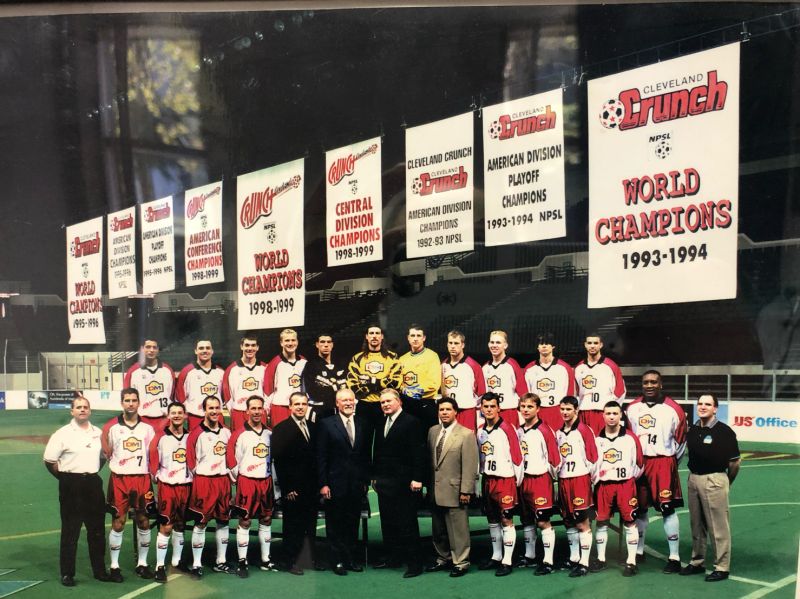
With the 1992-93 NPSL season for the Crunch, came a new venue to call home. The Convocation Center. Built on the campus of Cleveland State University, this 13,610 seat arena gave a smaller, yet more intimate atmosphere for the Crunch fans to cheer on and support them in this new exciting, high scoring era that would capture the majority of hearts in the city. This building, opened in 1991, also serves as the home of the CSU Vikings basketball teams. While Gund Arena (now known as Rocket Arena), located downtown next to the home of the Indians (now Guardians), broke ground in 1992, it wouldn’t officially be ready to open until 1994, making the Convocation Center the largest arena in the City of Cleveland (and second in the State of Ohio, only to the then Riverfront Coliseum, now Hertiage Bank Center) for a short time. The Crunch were considered an expansion squad by NPSL standards and therefore could only keep six players from their MSL days. Naturally, Hector Marinaro and Zoran Karic made team building easier to build around as they were easy choices to make when building a roster that could contend in the NPSL right off the bat. The Crunch were ready.
ATTACK! ATTACK! ATTACK!
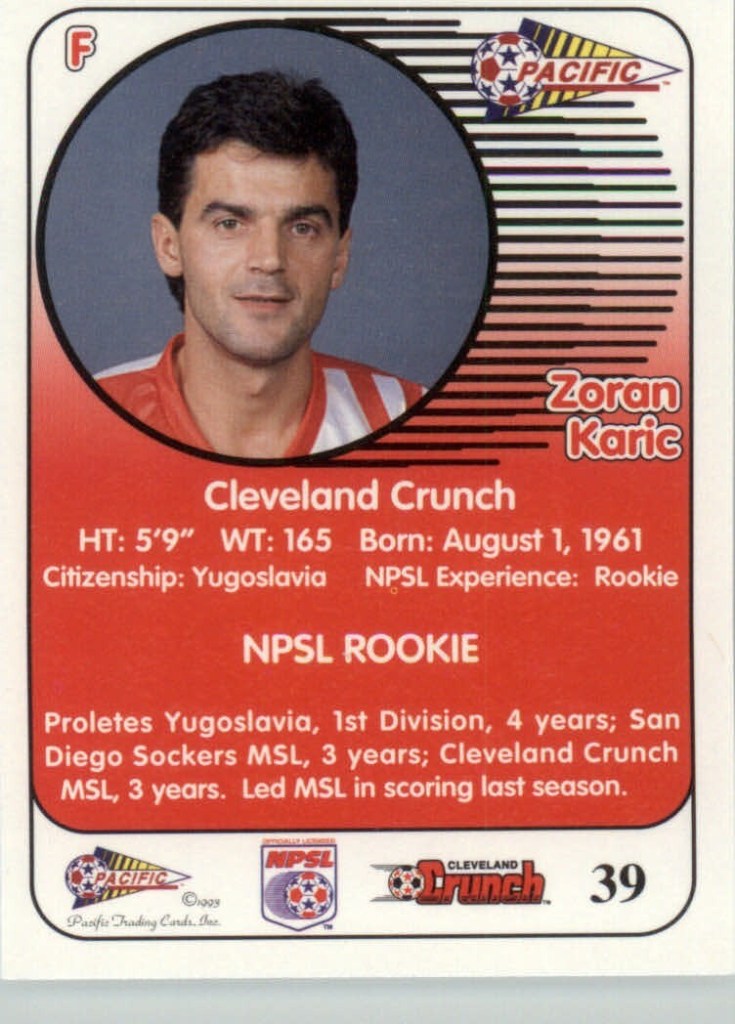
With Zoran Karic back in action, the Crunch offense was humming again.
The 1992-93 NPSL season brought more of the same as it came to the Crunch onfield success. 6677 Packed the Convocation nightly to witness a new era in Crunch arena soccer. This year saw a 40 game regular season for 13 seperate teams in two divisions, American and National, with the Crunch playing in the American Division along with the Baltimore Spirit (formerly Blast, who folded, then saw new ownership, similar to what Cleveland did, embrace a new era and identity all together), Buffalo Blizzard (who initially had plans to join the MSL but settled for the NPSL due to the former’s instability.), the Harrisburg Heat, Dayton Dynamo, Detroit Rockers, and last but not least, the five-time league champions (85, 86, 88, 89, 90), the Canton Invaders. While the National Division featured the Wings, the Kansas City Attack (who relocated from Atlanta, keeping the original team name, instead of opting to change it to the formerly folded Comets, mirroring decisions made by Cleveland and Baltimore in recent years), the Chicago Power, St. Louis Ambush (relocated from Tulsa, likewise keeping the original team name instead of opting for “Steamers or “Storm”, similar to the decision made by the Attack in Kansas City), the Wave, and the Denver Thunder (Denver had an MISL team known as the Avalanche that played two seasons in 80-81 and 81-82, making the playoffs in the latter year while playing their home games at the now demolished McNichols Sports Arena, years prior to the NHL).
Just like old times in the MISL/MSL, Baltimore always seemed to be just one step ahead in the regular season, as the Crunch, while going a respectable 25-15, sat in second behind the Spirit who went 27-13 to claim the American Division crown. Wichita (27-13) and Kansas City (26-14) were the only other teams with better records giving the Crunch the NPSL’s fourth best record overall heading into the postseason. Cleveland had no issues scoring as they now boasted the league’s top two scorers with Marinaro (100-50-248) leading the way, while Karic (78-72-222) was just as potent as ever. With the top four teams in each division making the playoffs, the Crunch would face off against Buffalo in the first round. Another sports city known for its suffering that needs no introduction, though Buffalo has its own team that has made them a City of Champions as well. In a high scoring game one, the Blizzard struck first with a 20-12 win. The Crunch fought back in game 2, winning 12-6. Game 3 came up roses for Cleveland as the Crunch took down the Blizzard 13-6 to reach the American Division Finals. Their opponent? The Harrisburg Heat, who downed Baltimore 16-3 and 22-9 in back to back beatdowns to reach the Division Finals themselves. Defeating Harrisburg would prove to be no easy feat, despite winning game one at home 16-15. Harrisburg would silence the doubters in game two 20-18 setting up a pivotal game three, winner take all. There would be no surprises or upsets this time, as the Crunch extinguished the Heat 16-7 in front the Convocation Center crowd to win the American Division in their inagural NPSL campaign. Their final test? The Kansas City Attack, who defeated Chicago two games to none and longtime rival St. Louis two games to one (including 16-14 in a thrilling game three of the National Division Finals) for the right to face off against Cleveland. The NPSL Finals would be a best of five tilt for these two powerhouses. Kansas City set the tone early and often in the first two games winning 18-6 and 12-8 to go up 2-0 in the series, but Cleveland proved why they belonged in this event, coming back to force game 5, winning 17-12 and 19-16 in games three and four respectively, in front the friendly confines of the Convocation Center crowd once more, proving just how lethal the Crunch were to play in their home. But Kansas City, who beat out Cleveland by a game in the regular season for what essentially was the right to host this sort of game, proved why, silencing the Crunch offense 19-7 to take home the 1993 NPSL Championship. Cleveland, once again, came ever so agonizingly close to reaching the top of the mountain but couldn’t dig deep to pull out that last effort when it mattered most, thus was foiled again, leaving the fans heartbroken yet again. However, 1994 would be the breaking of new ground for the Crunch. The chapter you’ve been waiting for, has arrived.
CITY OF CHAMPIONS!
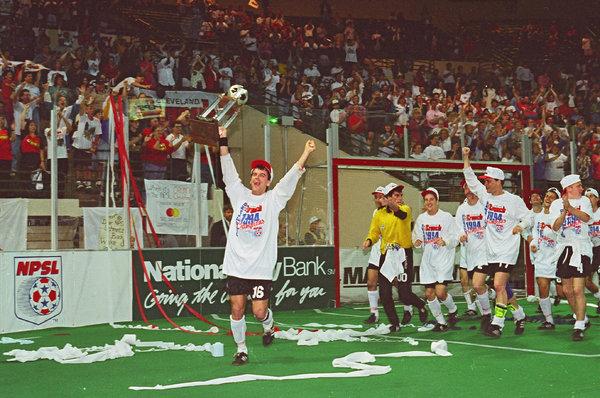
Champions at last! The Cleveland Crunch won the 1994 NPSL Championship.
In 1993-94, the Crunch took a slight step back record wise at 23-17, yet were still able to finish fourth in the NPSL overall again. Only Baltimore (26-14, who won the American Division crown), St. Louis (25-15, winners of the National Division), and Detroit (24-16, runners up in the National Division) had better records. An average of 6677 would come to watch this historic season unfold nightly. Just like last year, the Crunch would boast the NPSL’s top playmakers, this time seeing Karic lead the way (85-104-267), with Marinaro, who once again, led the league in goals (113-43-253). Karic, was named the MVP for his efforts this season, something Marinaro did the previous year. With yet another runner up finish to the Baltimore Spirit, would this year be any different for the Crunch? Harrisburg, once again, proved that Baltimore was no match for them in the playoffs, losing to them 21-9 and 13-7 to send the Spirit home early again. Cleveland faced off against Buffalo in the first round again. This time Cleveland won at home in game one in an absolute scorefest, 24-16. The Blizzard proved to be a worthy opponent once more, forcing a game three at Convocation, with a game two win, 16-12. Game three would once again, prove why the Crunch were lethal at home, weathering the Blizzard, 13-8 to play against Harrisburg in the American Division Finals for the second straight season. Harrisburg was really something else back in their NPSL heyday as they always proved to be a thorn in everyone’s side come playoff time. Game one was their day indeed, as they edged out the NPSL’s top attack 14-13 to pick up a crucial win on the road in arguably the most difficult venue to play at in the NPSL. Cleveland, with their backs against the wall, fought back to force game three, winning 15-10, to give themselves another winner take all game three at home. This year proved to be no different once again, as the Crunch cooled off Harrisburg 21-10 to make it back to the NPSL Finals. This time, they would face off against the St. Louis Ambush who beat Milwaukee two games to one and Detroit two games to none to clinch the National Divisional Finals. Would the Show-Me State foil Cleveland for the second straight season? Or would the Crunch clinch the city’s first professional sports championship since 1964, when the Cleveland Browns won the NFL Championship that year? A moment 30 years in the making was about to unfold. The Ambush made a statement to the Crunch with a game one win, 26-6. But Cleveland wasn’t going to be denied their first banner in 30 years so easily, winning 21-14 to send the series back to the Convocation Center with the series tied at 1-1. Game three at home proved to be just what the doctor ordered, as the Crunch ambushed St. Louis 29-8, giving the city of Cleveland its first moment in 30 years to clinch a banner and be called “City of Champions”. St. Louis, however, wasn’t going to go away quietly either, coming out in game four and scoring like they did early in game one. But on this day, the City of Cleveland, Ohio would finally have their chance to shine, as the Crunch outlasted the Ambush 17-15, to clinch the 1994 NPSL Championship, the city’s first banner in 30 years, when the Browns won the second to last pre Super Bowl NFL title.
The City of Cleveland, Ohio, thanks to the beautiful game indoors, was a city of champions once again. A moment they would cherish for a lifetime. And they were not done either. The Crunch still had the best offense in the NPSL. Would they defend their title? Or would there be a new champion in the NPSL?
DEFEND THE LAND….
The Crunch picked up right where they left off in 1994-95, this time going 30-10 (tied with the Ambush for the best record in the league), while winning their first American Division crown. 7579 came out on average to watch their defending champions play. In an event that came as absolutely no surprise to anyone, the top two playmakers belonged to the defending champions. Hector Marinaro took the scoring and goal scoring title this year, earning him the MVP (99-53-255), while Karic was the only other 200 point scorer, though he finished 5th in goals scored this season, he led the NPSL in assists (78-96-241). The Crunch would face off against Buffalo in the first round for the third straight year. Just like last year, Buffalo took game two at home 21-19 after dropping game one on the road, 22-10, setting up a pivotal game three. This year, just like the previous two, belonged to the Crunch in front of their home crowd, 19-15. Up next? Harrisburg (AGAIN?!). Yes, while the Heat were a much better squad finishing second in the American Division, they beat Baltimore two games to one this time, but still soundly beat them in their two wins 17-4 and 14-6, proving the Spirit still didn’t hold a candle to the Heat. Even the loss was a tight one at 17-15. Would the Heat capture their first trip to the Finals? The answer to that question was a shocking, convincing, and resounding YES. Harrisburg not only defeated the defending champs, earning them a trip to the finals, but they did so in just three games, putting the clamps on Cleveland 17-7, 24-18, and 16-12 to make short work of the Crunch on their way to capturing the American Division Finals. St. Louis would take them on after polishing off Detroit two games to none and outlasting their rivals, the Kansas City Attack three games to two (including 40-22 in game one! And 25-14 in game five at home). Sadly, this would be the closest the Harrisburg Heat ever got to winning the NPSL, as the Ambush made quick work of them in the 1995 NPSL Finals putting them down in a four game sweep (1995 saw the NPSL Finals become a best of seven series) winning 19-8, 18-8, 12-7, and 14-11 to give the City of St. Louis another banner next to their beloved Cardinals. While 94-95 was a disappointing year for the now former defending champs from 1994, the Crunch weren’t going anywhere either in the near future.
RUN IT BACK
It was safe to say the Cleveland Crunch were NOT happy losing to the Harrisburg Heat in the American Division Finals, denying them a chance to repeat as NPSL champions last year, as they tore up the American Division, winning it with a 31-9 record (second league wide to the Attack, who just edged them out at 32-8). A new benchmark in nightly attendance at 7647 also gave Cleveland the mojo they needed to get back on top of the arena soccer hierarchy where they belonged. Hector Marinaro, would pace the Cleveland offense once more as the NPSL’s top goal scorer and scorer overall (96-58-247), although this year, he would share the MVP honors, not with his team mate Zoran Karic (62-61-184), but the NPSL’s Goalkeeper of the Year for the Milwaukee Wave, Victor Nogueira. Four years, four straight times that Cleveland would face the Buffalo Blizzard in the first round. And, just like the previous meetings, Buffalo could protect home field in game two, but couldn’t defeat the Crunch in either game on the road, losing games one and three, 25-15 and 17-11 respectively. This time, however, Baltimore was able to finally overcome their own playoff demons (much like the Force did in their MISL days), defeating the Heat 16-11 and 7-6 to win their first round series two games to none. With the Cleveland vs. Baltimore rivalry renewed just like old times, it would be Crunch vs. Spirit in the 1996 NPSL American Division Finals. Cleveland got out to a much better start in the Division Finals this time, taking games one and two 15-11 and 16-14. The Spirit took game three 23-14 to give themselves one more chance at home to recapture the old magic the Blast used to inhabit at their home venue in the Charm City, but Cleveland would show the Spirit that it was a new day and there was a new Sheriff in town, as the Crunch redeemed their loss in the American Division Finals from last year with a tight 13-12 win on the road for a chance to capture their second NPSL title in three years. The opponent was none other then the team that soundly beat them in game five of the 1993 NPSL Finals, the Kansas City Attack. With a best of seven series to decide the champion this time, would the Crunch take the extra opportunities to defend against the Kansas City Attack? The Attack were off and running towards a second title against the Crunch, winning the first two games at home, 28-18 and 22-17. Down two 2-0, the Crunch proved one more that they were a deadly opponent on their home turf at the Convocation Center, just like three years ago. Cleveland, defended their home turf with honor, just like they did in 1993, but this time winning games three, four, and five at home, 24-12, 19-9, and 20-16 to set up another opportunity to finally withstand the Attack at Kemper Arena in game six. In a much tougher game, but with a renewed sense of fighting spirit, the Crunch would overcome the playoff demon that haunted them in the 1993 Finals and defend Kansas City long enough to capture their second NPSL Finals in three years, 16-12. Cleveland, Ohio was a City of Champions once again in 1996.
And all thanks to the beautiful game indoors. They were gonna need it too in 96.
OUR TOWN, OUR TEAM, OUR CHAMPS
In 1996-97 with the loss of their beloved Browns, the Crunch had major Dawg Pound size cleats to fill for the City of Cleveland sports scene. For this season, the NPSL split their standings into American Conference East and Central Divisions and National Conference Midwest and North Divisions, beginning in 96-97. Taking up the Central Division with the Crunch were the Cincinnati Silverbacks and Columbus Invaders giving three Buckeye State teams for the division, while the East Division rolled out with the Harrisburg Heat, Philadelphia Kixx, Baltimore Spirit, and Tampa Bay Terror. The Midwest featured the St. Louis Ambush, Milwaukee Wave, Kansas City Attack, and Wichita Wings. Finally, the North Division was the home to the Buffalo Blizzard, Detroit Rockers, Toronto Shooting Stars, and the Edmonton Drillers. With a new and seemingly improved 15 team league, what did the first post Browns season have in store for the Crunch? A record nightly average of 8044 hit the turnstiles this season, giving the Crunch all the motivation they needed to prove that Crunch-Time was at a fever pitch once more. With Hector Marinaro (104-65-265, lead the league in Goals and Points) winning MVP once more, and Zoran Karic (81-81-242, lead the league in Assists) pacing the Cleveland offense once more, the Convocation Center was the place to be during the hot winter nights between the turf and boards.
This season would also feature a new playoff format, as the top six teams in each conference qualified for the playoffs. The top two seeds in each conference were given to the division winners, while the remaining four seeds would go to the best four non division winners. In the Conference Quarterfinals, the three seed would play the six seed, while the four would take on the five. The series would be best of three. The highest seed to advance would play the two seed in the Conference Semi-Finals, while the lowest would play the first overall seed in the conference. The Conference Semi-Finals would also be best of three. The Conference Finals would be a best of five series, while the NPSL Finals remained a best of seven series. With me so far? I know thats a LOT to digest compared to last season.
While the NPSL playoff format due to the new division and conference structure has changed, the amount of regular season games remained at just 40. The Crunch christened their new Central Division (and two in-state rivals) by capturing it with a solid 29-11 record, tops in the NPSL during the regular season, while Harrisburg captured the East going 22-18, the Blizzard won the North at 21-19, and St. Louis captured arguably the toughest division that year, the Midwest, at 27-13. Milwaukee and Kansas City each went 26-14, while Wichita went 24-16, proving just how rugged the Midwest Division was being a “Group of Death” and “Murderer’s Row” of sorts.
The 1997 NPSL Playoffs saw Baltimore(4) defeat Philadelphia(5) two games to none, Cincinnati(3) defeat Tampa Bay(6) two games to one in the American Conference Quarterfinals, while National Conference Quarterfinals saw Edmonton(6) upset Milwaukee(3) two games to none and Kansas City(4) defeat longtime rivals Wichita(5) two games to one. The National Conference Semi-Finals saw St. Louis(1) survive against Edmonton two games to one, while Kansas City(4) became the latest team to victime the Buffalo(2) fanbase, two games to none. In the American Conference, Harrisburg(2) took down Cincinnati(3) in two tight contests, two games to none to set up Cleveland potentially facing off with the Heat once again in the Conference Finals. Baltimore would add to Cleveland’s misery, as if stealing the Browns to create the Baltimore Ravens wasn’t bad enough, winning 19-14 in game one, faced with a humility they never knew would come their way, the Crunch won on the road in enemy territory, 21-9, to set up game three. The Crunch would exact some revenge for losing their NFL Franchise to the City of Baltimore (although it can be argued the way the Colts moved from Baltimore to Indianapolis may have been a lot worse) winning game three 14-13 to set up yet another rematch with Harrisburg with a trip to the NPSL finals on the line. The National Conference Finals set up a battle for the Show-Me State with the Attack facing the Ambush. Kansas City proved their worth by taking this one in three straight, 15-11, 22-16, and 13-11 to win the National Conference Finals three games to none in a sweep. As for the American Conference Finals? The first two games were split, with Cleveland winning game one 11-8 and Harrisburg taking game two, 19-13, proving just how pesky they are to defeat come playoff time. With the series heading back east to Keystone State, the Crunch proved to the Attack they would be a handful in the 1997 NPSL Finals as they took games 3 and 4 in Harrisburg, 17-14 and 14-12 to capture the American Conference Finals, three games to one. The 1997 NPSL Finals would prove to be Kansas City’s redemption arc this time around, as the Attack with knock aside Cleveland 18-14, 25-19, 14-8, and 15-12 to capture their second NPSL Finals in five years four games to none in a sweep, proving just deep and tough their division was all year and getting them ready come playoff time as they had the NPSL’s third best record during the regular season, but were the fourth seed in the National Conference during the playoffs, making them fly under the radar. Another chance to defend their title lead to another sweep in the playoffs, adding to the already heartbreak citizens in Cleveland have had to endure in the sports world in 1996 and 1997. Though that heartbreak wasn’t the last they would face that, as the Florida Marlins won the 1997 World Series defeating the Cleveland Indians 4 games to 3, with game 7 going to 11 innings.
A CITY OF HEARTBREAK
The Crunch would see some changes during the 97-98 NPSL season, as the league would reshuffle a few teams in different places. Milwaukee was now in the Central Division of the American Conference with Cleveland and Cincinnati (Columbus folded), while the East Division had Philadelphia, Baltimore, and Harrisburg (Tampa Bay folded, something their MLS team would follow suit on a few years later) The National Conference North Division saw a new team in the Montreal Impact (no, not THAT Montreal Impact) along with Buffalo, Edmonton, and Detroit (Toronto also folded), while the Midwest Division now just had Kansas City, St. Louis, and Wichita. Would the arrival of Milwaukee threaten the two champs in the new and improved Central? Or was it still Cleveland’s to lose?
97-98 saw the largest nightly attendence average the Convocation Center would see during the NPSL era, as 8265 would pack the arena to see this proud championship team of theirs. Milwaukee proved just how good they were playing in the tough Midwest Division last year by winning the Central, going 28-12 in the process. The Crunch finished second with a pedestrian 21-19 compared to previous years, proving the Wave were the new Kings of the Central. Philadelphia won the East with a 26-14 record to take the two seed in the American Conference, while the Midwest saw St. Louis go 27-13 to capture the title once more. The North was won by Buffalo, who went 21-19 as well. Cleveland sat with the leagues fifth best record overall this time around. Would the playoffs be any different? Marinaro still proved the scoring and goals scoring title, belonged to him (87-43-212) while Nogueira would win the MVP and Goalkeeper of the Year in netminder for Milwaukee. Zoran Karic still remained 2nd in the NPSL in scoring, while remaining the NPSL leader in assists (62-91-206). The playoffs still featured a conference quarterfinal round, although this was reduced to the top five teams in each conference making the playoffs the with same rules applying to seeding structure. Only there was a lone 4 vs. 5 in the quarterfinals to face off against the top seed while the second and third seeds met in the semi-finals. This years quarterfinals saw defending champion Kansas City(N4) take down Edmonton(N5) two games to none, while Harrisburg(A4) overcame a 27-5 loss in game two to defeat Cincinnati(A5), two games to one. Cleveland(A3) would not get another chance to face Milwaukee, as Philadelphia(A2) defeated them 10-4 and 29-27 in two straight to take the two game sweep. Milwaukee(A1) took Harrisburg(A4) two games to none for the right to face the Kixx. St. Louis(N1) avenged last years defeat to Kansas City(N4) knocking out the reigning champs two games to none, while Wichita(N2) sailed past Buffalo(N3) two games to none for the chance to take down the rival Ambush in the National Conference Finals. In the Conference Finals, Milwaukee overcame dropping the first game to take the next three, advancing to the 1998 NPSL Finals three games to one, while St. Louis ended the season of the Wings, three games to one to capture the National Conference to set up a Midwest showdown. In the Finals, the Ambush could only muster a game four win at home, as the Milwaukee Wave would power past them four games to one to take the 1998 NPSL Finals. After another disappointing defeat, this time at the hands of a new division rival who sit on top of the throne, what would it take for Cleveland to get back on top? Would they?
ONE MORE ROUND….
The Crunch proved just how resiliant they were during the 98-99 season. Attendence stayed strong with an average of 8034 a night packing the Convocation Center. But a long lost, beloved squad would soon be making their return to Cleveland Stadium before long, in 1999. This fortunate turn of events would certainly lead to a drop in attendance over the remaining years of the Crunch franchise. The NPSL was at 13 teams for the 98-99 season with a new team, the Florida Thundercats (based in Ft Lauderdale, in the greater Miami-Dade County area, like their NHL counterparts, the Florida Panthers, were given a feline based mascot, though the Thundercats would fold after the season) playing in the East, while the Central now saw Montreal paired with Milwaukee and Cleveland as new divisional roommates (Cincinnati folded). The National Conference saw no change outside of Montreal, as the other teams and divisional alignment remained the same. The playoff format remained the same as well for the 1999 NPSL Playoffs, with the only changes being the Conference Finals being a best of three series and the 1999 NPSL Finals scaling back to a best of five series. All other rounds remained best of three. Hector Marinaro was still the top goal scorer and points leader (84-38-195), although Buffalo’s Doug Miller pressed him goal and point wise (82-23-194), he would unseat Zoran Karic as the leagues second leading scorer this year after being second for all but one year since coming over to the NPSL in 92-93. Karic would still lead the league in assists while finishing sixth in scoring overall (49-59-150). Marinaro was named MVP once more, reclaiming the title he often held in years past. Cleveland took the division crown back from Milwaukee, going 26-14, best in the NPSL overall and winning it by just one game. Philadelphia would pick up the two seed in the American Conference, winning the East at 23-17. St. Louis won the Midwest, going 21-19, while Edmonton won their first North Division title, going 23-17 overall. The Conference Quarterfinals saw Kansas City(N4) defeating rival Wichita(N5) once again, two games to one, while Montreal(A5) would upset Harrisburg(A4) two games to none. The Conference Semi-Finals would see Edmonton(N1) overcome Kansas City(N4) to reach their first conference finals, two games to one, St. Louis(N2) becoming the lastest team to hand Buffalo(N3) yet another playoff defeat two games to one, Philadelphia(A2) would take down Milwaukee two games to one, while Cleveland(A1), with the prospect of not having to face Milwaukee again, would still face a stiff test against Montreal (A5), losing game one 10-9, but would rebound to take the series two games to one after winning games two and three 28-11 and 15-9. The National Conference Finals would see St. Louis end Edmonton’s dream run, two games to none, while the Crunch had another chance to execute a playoff demon that eliminated them the year before in Philadelphia. The Crunch provided a rare shutout (much less a PLAYOFF shutout) in this series, winning game one at home 30-15, while shutting down the Kixx 15-0 to capture the American Conference, setting up a another showdown with the Ambush. After taking the first two at home, 20-9 and 21-10, the Ambush fought back to force game five, winning 14-12, and 12-8. The Convocation Center proved to be just what the Crunch needed to get over the hump and pick up their third NPSL Championship in six years, defeating St. Louis 18-12, winning three games to two. The Crunch had done it once again.
CLEVELAND ROCKS…..
The Crunch had not only made Cleveland a City of Champions three times in the past six years, they provided a much needed lifeline to Cleveland sports fanatics after they lost the Browns, who became the Baltimore Ravens. This 1999 NPSL Championship would ultimately prove to be the last great moment in this historical run for the Crunch provided by the beautiful game indoors.
SOMETHING OLD, SOMETHING NEW….
With the Cleveland Browns back in their rightful place among the teams in Cleveland, Ohio, the Crunch faced new and exciting challenges that began during the 1999-2000 season. Only 6290 showed up for games on average this year, as the Crunch would see another division and alignment shakeup with the Thundercats not returning. The only changes saw Milwaukee move to the North, pairing them with Edmonton and Detroit, while Buffalo came over to the East, pairing them with Montreal and Cleveland. Both East and Midwest remained the same. That left 12 teams, with three in each division, six in each conference. With one less team in 99-00, the NPSL scaled back the playoffs, eliminating the quarterfinals, while the first two rounds remained a best of three series. The 2000 NPSL Finals would be a best of five series. For the first time since coming over from San Diego, Zoran Karic would not be roaming the Crunch sideline ready to set up Marinaro, as the team decided to not sign him. Hector Marinaro was still as lethal as ever leading the league in points scored and goals scored (103-34-231), earning him MVP despite not having Karic beside him this year. The NPSL would play a 44 game regular season schedule this year. Cleveland remained on top in the Central, going 27-17, best in the American Conference and second in the league to Milwaukee, who won the North at 31-13. The Blast name and branding returned to Baltimore the previous season, but the old Blast magic was back as they took the East at 26-18, just behind the Crunch. Kansas City took the Midwest going 24-20. Cleveland took down Montreal two games to none, 21-7 and 21-11, while they would meet Baltimore in the 2000 American Conference Finals after defeating Philadelphia two games to none. The National Conference Semi-Finals saw defeat Wichita two games to none, while Edmonton upset Kansas City 26-25 and 15-14 to take this series two games to none, setting up back to back trips to the National Conference Finals. Milwaukee would end their run two games to none, while Cleveland proved there was still a little magic left in them, defeating Baltimore 28-18 and 25-22 to win the American Conference Finals two games to none. The 2000 NPSL Finals featured another Cleveland vs. Milwaukee matchup, just like it was meant to be. Cleveland took game one at home 20-18 while Milwaukee countered in game two, winning 18-12. Game three in Wisconsin saw the Crunch put themselves one step closer to going four in seven years with a decisive 27-15. But alas, Milwaukee would not only win game four at home 14-8, they would do the one thing that didn’t seem possible going into this game, winning a potential game five in Cleveland, but the Wave did just that, sending the fans home unhappy with a resounding 19-6 thumping that made Milwaukee champs in two of the past three seasons.
A NEW CHALLENGER
The 2000-01 season was a sign that times were beginning to change. And certainly in ways the Crunch fanbase would not like, either. While a slight bump in attendence saw 6317 show up per game, the Crunch would fail to make the playoffs for the first time since their first season in the MSL in 1989-90. Hector Marinaro still hadn’t lost his touch either, though, leading the league in scoring once more (63-41-161), although THIS time, he would only be second in goals scored to Baltimore’s Denison Cabral. Harrisburg’s Gino DiFlorio would take home the MVP. Other changes that took place in 2000-01 saw a new Toronto team, the ThunderHawks (based in Mississauga, Ontario) take the field, while Edmonton folded after playing only nine games. This left the NPSL at 10 teams by seasons end, five in each conference. The NPSL returned to a 40 game regular season schedule. The American (although it could be considered the Eastern) Conference consisted of Baltimore, Philadelphia, Harrisburg, Buffalo, and Cleveland, while the National (or Western Conference, it could be argued), consisted of Milwaukee, Toronto, Kansas City, Wichita, and Detroit (St. Louis sadly folded). The top four teams in each conference make the playoffs with the first two rounds consisting of a best of three series, while the 2001 NPSL Finals will remain a best of five series. Detroit and Cleveland were the only teams to miss the 2001 NPSL Playoffs, although Wichita (18-21, missed out on a game thanks to Edmonton folding) and Kansas City (14-26) made the playoffs in the National Conference, Cleveland faced a tougher slate as Buffalo, Baltimore, and Philadelphia went 22-18 while Harrisburg took the top seed, going 24-16. Milwaukee took the top spot out west at 24-16, matching the Heat while Toronto finished 21-19 just behind the Wave. In the first round of the 2001 NPSL Playoffs, Philadelphia upset Harrisburg two games to none, Baltimore eliminated Buffalo two games to none in the American Conference while Toronto defeated Wichita two games to one and Milwaukee survived what would have been a jaw-dropping at the hands of Kansas City, winning game one 22-7, losing game two 12-2, and surviving game three at home 22-17. In the Conference Finals, Philadelphia reached the Finals defeating Baltimore two games to one, including a thriller in game three, 16-15, while Milwaukee swiftly ended Toronto’s run two games to none. In the 2001 NPSL Finals, the Milwaukee Wave took down the Philadelphia Kixx in three straight, 16-12, 9-8, and 10-8 for the three game sweep of the NPSL Championship. With Milwaukee repeating as NPSL Champions, could the Crunch beat counted on to get back and give it one more go around for Hector Marinaro?
MISL VERSION 2.0?
The MISL name and branding would make a return from 2001-08
If the Edmonton Drillers folding nine games into their season wasn’t a huge red flag of things to come, then it shouldn’t come as a surprise that the NPSL, just short of a two decade run, folded up shop in 2001, just like the first incarnation of the MISL/MSL did in 1992 and the CISL in 1997 shortly afterwards while the NPSL seemed to be going on strong then. It lasted longer than any other arena soccer league had to date. The six teams that survived to form this second iteration of the Major Indoor Soccer League (MISL), were the Baltimore Blast, Harrisburg Heat, Philadelphia Kixx, Kansas City Comets (who decided to restore the historical name with a move to the league that it originally called home in the first MISL), Milwaukee Wave, and of course the Cleveland Crunch. With a single table of six teams to go up against this year, each team would play a 44 game schedule. The top four teams would make the MISL playoffs in the 2001-02 MISL season, with the first round being a single game and the 2002 MISL Finals being a best of three series. The Crunch would see Marinaro finish second in scoring (the scoring rules from the NPSL carried over to the new MISL) while leading the MISL in assists (60-73-188). Cleveland, like their first year in the MISL and NPSL, would miss the postseason. At 16-28, they missed the playoffs by two games. Safe to say only drawing 4688 fans a night didn’t help matters much, though this was very similar to previous first year seasons in the MSL and NPSL. Milwaukee topped the standings at 34-10, while Philadelphia (30-14), Kansas City (24-20), and Baltimore (18-26) made the postseason. Harrisburg finished dead last at 10-34, a farcry of what they used to be in the NPSL. Milwaukee defeated Baltimore 18-12 while Philadelphia defeated Kansas City 18-13 to set up a rematch between the Kixx and Wave. After losing 11-4 in game one, Philadelphia rebounded to win game two at home in the Philadelphia Spectrum, 11-4. Game three proved to be a fitting end for the Kixx as they walked into Milwaukee and took down the Wave to win 8-6 for their first arena soccer World Championship. With similar growing pains for the Crunch, can another rise to glory be expected for Cleveland? Or was this the beginning of another end? Was the answer in restoring a long lost identity of relics in the past? Which reminds me……
OLD FRIENDS, OLD RIVALS
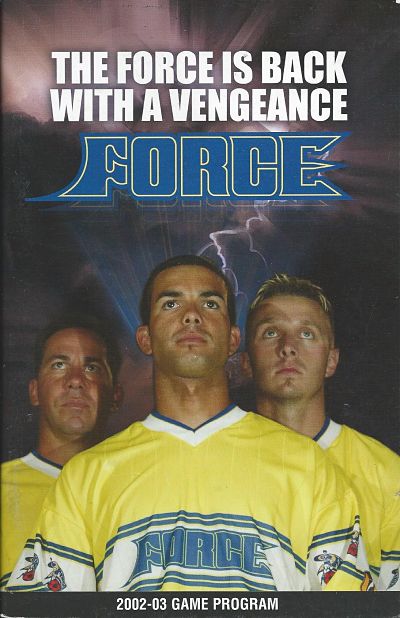
The Cleveland Force name and branding was restored in 2002
The return of the Cleveland Force brand and name would follow similar patterns of the new MISL looking to capitalize on the glory days and golden age of arena soccer. From Cleveland to Kansas City, St. Louis to Dallas and perennial champions San Diego, the new MISL was here to establish a new (old) era of arena soccer built to last. Except it wouldn’t last half as long as the original MISL.
The Force would see a slight bump in attendence for the 2002-03 season with 5381 packing the Convocation Center nightly. The MISL saw an increase to eight teams this season, with the Dallas Sidekicks and San Diego Sockers joining over from the World Indoor Soccer League (WISL, no relation to the CURRENT WISL). The regular season was also shortened to 36 games this season. The top three teams in each conference would make the 2003 MISL Playoffs, with the two seed hosting the three side in a single game while the conference finals would be a single game as well, the 2003 MISL Finals would remain a best of three series. The Western Conference would have Milwaukee, San Diego, Dallas, and Kansas City, while the Eastern Conference would feature Baltimore, Philadelphia, Harrisburg, and Cleveland. Cleveland would finish second in the East, at 19-17, while Philadelphia took the East going 24-12. Milwaukee would take the top spot out west at 28-8. Despite a return to the playoffs, Baltimore would show off some of their old MISL magic in the postseason, just as they did previously against the Force, winning 16-14, while Kansas City gave San Diego a 13-11 defeat in their first playoff match against one another in almost two decades. In the Conference Finals, Baltimore defeated Philadelphia 8-6, while Milwaukee took down Kansas City 20-19. In the 2003 MISL Finals, Milwaukee beat Baltimore in game one 19-13, but that old Blast MISL magic still came around, with Baltimore claiming wins 15-12 in game two and 13-12 in game three to capture their first World Championship in arena soccer since winning the 1984 MISL Championship, 19 years prior, making Baltimore a City of Champions once again.
With the rise of the Baltimore Blast, do the Force have much more left in the tank? Or is this truly the end of a golden era for success starved Cleveland fans?
HEY, DO I KNOW YOU?
The 2003-04 MISL season saw a dip in fans per game at 4955, the first time Cleveland averaged less than 5000 a game since 1990-91, their second season in existence. The MISL would expand to nine teams in 03-04, with the addition of the Monterrey Fury. Also adding to the changes are three divisions of three teams each, eliminating conferences. With a Eastern, Western, and Central Division on tap, the Force would be paired with Philadelphia and Baltimore in the Eastern, while San Diego, Dallas and Monterrey made up the Western, Finally, the Central consisted of Milwaukee, Kansas City, and the St. Louis Steamers (like Kansas City, they decided to restore their former MISL team name that was bestowed upon them from the glory days). Harrisburg would fold, ending the Heat’s original run. Scoring would return to a more traditional one point goal and assist scoring method beginning this year thanks to a controversial goal in last years playoffs. A 36 game schedule would remain, while, seeding was determined by overall record. The playoff format saw the first two rounds remain a single game contest, while the 2004 MISL Finals would now become a best of five series. The six would play at the three seed while the four hosted the five. Lowest seed would advance to play the top seed, while the higher seed advanced to play the two seed. The Force would go 15-21 this year, good enough for the sixth and final playoff spot overall. They would be matched against Dallas in the first round, falling just like they to them in 1984, losing 7-4, ending their season. Kansas City defeated Philadelphia 8-5 to advance to play Milwaukee. The Wave would return to the MISL Finals, defeating Kansas City 7-3, while Baltimore would return to the Finals after defeating Dallas 6-1. In the only MISL Finals for the second iteration of this league that would see a best of five format, the Blast repeated as MISL Champions in 2004, sweeping aside Milwaukee three games to none, 12-3, 8-4, and 6-2 at home to finish the three game sweep.
And with that lastest defeat, the Cleveland Force would come back for just one more season to leave a mark on the City of Cleveland Sports scene in 2004-05.
THE FINAL COUNTDOWN
This season would ultimtely be the last in the run that was the Cleveland Crunch/Force. 2004-05 would see even less fans in attendence at 3639 per contest at the now newly named Wolstein Center on the campus of Cleveland State University. John Ball would provide scoring punch lacking since Karic and Marinaro ruled the box in Cleveland (30-31-61). Ball would finish second in league scoring as well. Force Coach Omid Namazi would take home Coach of the Year. San Diego would fold after new owners were found to not be paying staff and players, along with the Monterrey Tigres (formerly the Fury). With both teams gone, along with the addition of the new Chicago Storm, the league sat at just seven teams at seasons end. As a result the league would play a 39 game regular season schdedule. Cleveland would finish one game behind Milwaukee for the best record in MISL at 23-16. The top four teams made the playoffs in the single table format this year, with both semi-final series and the 2005 MISL Finals being a best of three series. Milwaukee defeated St. Louis two games to none, while Cleveland would make it back to the Big Dance, defeating Philadelphia 6-3 at home in game one and 10-6 on the road in game two to take the series two games to none. The 2005 MISL Finals was the very last dance. Could Cleveland capitalize? Alas, no, such is the way of the Clevelandites, they should suffer yet again when all is on the line. Consecutive 10-9 wins by the Wave captured the 2005 MISL Championship for Milwaukee, two games to none, ending the run of what has been the greatest modern sports heroes in Cleveland sports history.
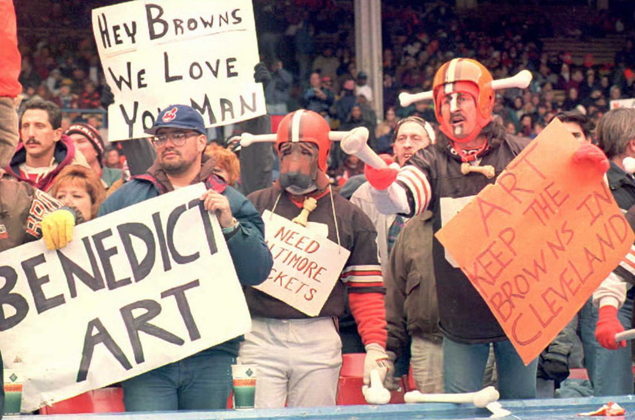
But the story of Cleveland’s success in sports didn’t dry up with the Crunch. During and after the original run, other teams would look to fill a void, just as the Crunch did upon the exit of the Browns in 1996 for Baltimore, their hated nemesis. What did the City of Cleveland have in store for them? Tune in Wednesday for part 3 as we bridge the gap from 2005 to…..2020? Yes indeed!


Leave a Reply